
Church Video Wall Comparison: LED vs. LCD vs. Projection
A church video wall is a large display used for song lyrics, scripture, sermon graphics, live camera images, and stage backgrounds. Direct-view LED is often the right choice for a broad, seamless image in a bright sanctuary. LCD can suit smaller rooms, while projection remains useful when lighting is controlled or a retractable screen matters.
The right worship display depends on what the congregation must read, the nearest and farthest seats, available mounting space, and the complete installed budget. A large screen alone does not guarantee readable lyrics, clean livestream footage, or simple Sunday operation.
Use this church video wall comparison when your committee is deciding between direct-view LED, LCD, and projection. Compare all three using the same worship slides, room lighting, viewing positions, and installed scope. Once LED is selected, continue with the church LED video wall buying guide for system specifications and quote preparation.
Request a church LED video wall proposal with your room dimensions, seating distances and installation location.
1. Why Your Church Needs a Video Wall
A church video wall earns its place when it solves a clear communication problem. Examples include lyrics that disappear in daylight, sermon diagrams that rear seats cannot read, or stage layouts that obstruct the existing projector beam. Establish which problem has priority before choosing equipment.
Make the message readable
Walk the sanctuary with a representative lyric slide on the current screen. Include the rear row, accessible seating, balconies, and seats beside the stage. Record where text is too small, the image is blocked, or contrast disappears. This creates a more useful brief than specifying a screen by congregation size alone.
For an LED wall, readable text depends on physical letter height, contrast, spacing, viewing angle, and pixel resolution together. Use short lines and restrained backgrounds. A sharper display cannot rescue tiny text, and adding pixels does not make letters physically larger.
Separate congregation, stage, and livestream needs
A scenic backdrop, congregation lyric display, and confidence monitor serve different audiences. One church video wall may handle several roles through separate content regions, but confirm the workflow. Musicians may need a dedicated confidence display showing the next lyric or a timer.
The livestream also needs its own graphics and camera composition. Filming the entire stage screen is not a substitute for a clean program feed. An LED surface produces an image; microphones, mixing, and loudspeakers remain separate systems. Plan visual and audio timing together when showing live speakers.
2. Church Video Wall Options: LED vs. LCD vs. Projection
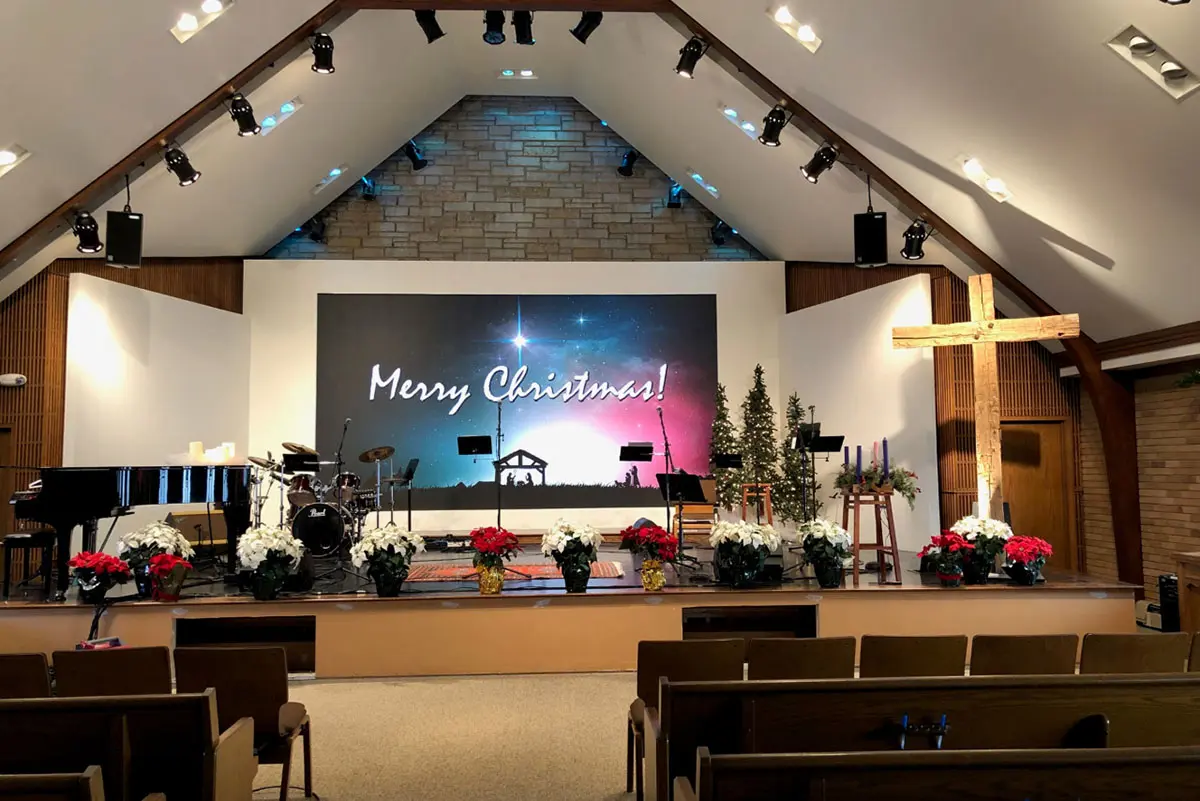
There are three main approaches to a large worship display: direct-view LED, tiled LCD, and projection. Strictly speaking, a projector and screen are not a modular video wall, but they compete for the same sanctuary display role. Compare them under identical lighting and with identical content.
On small screens, swipe horizontally inside each table to see every column.
| Decision | Direct-view LED | LCD display or wall | Projector and screen |
|---|---|---|---|
| Large image | Modular cabinets form a continuous image | Tiled panels leave bezel lines | Large image depends on lens, throw, and screen |
| Bright sanctuary | Useful brightness headroom; assess reflections | Choose output and surface finish for the room | Light falling on the screen reduces contrast |
| Close seating | Fine pitch may be needed to limit visible pixels | High pixel density can suit small displays | Resolution and image size determine pixel visibility |
| Physical constraints | Structure, power, cooling, and service access | Panel mounts, alignment, and replacement access | Clear beam path and correct lens placement |
| Maintenance | Replace compatible modules or electronics | Replace panels; check future matching availability | Model-specific cleaning and light-source servicing |
| Best starting application | Large sanctuary or stage display | Small chapel, lobby, or overflow room | Controlled lighting or retractable-screen requirement |
Church LED video wall
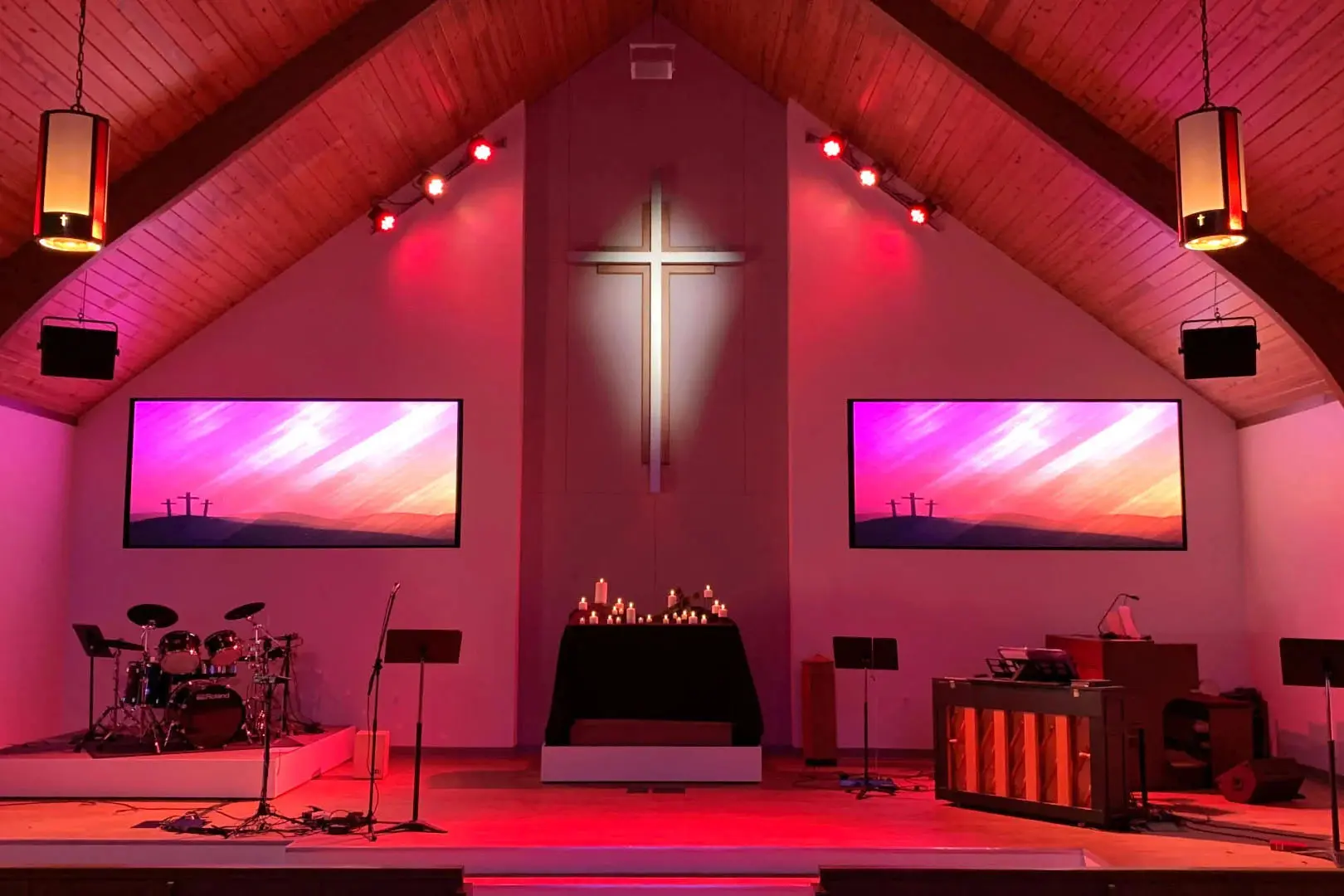
A direct-view church video wall uses LED pixels to emit light toward viewers. Cabinets combine into an image surface without LCD-style bezels, although poor alignment or calibration can still reveal module boundaries. Cabinet dimensions determine available screen sizes, and the processor maps content to the finished pixel grid.
Indoor and outdoor panels are different specifications. Do not assume an indoor church video wall tolerates rain because it uses LEDs. Likewise, a high maximum brightness does not establish comfortable dimming, good grayscale, or suitable camera behavior. Test the complete proposed configuration.
LCD screen
A commercial flat-panel display may be enough for a small chapel or classroom. A tiled LCD wall creates a larger image, but its bezel intersections can divide words and faces. Check whether a single large display or two independently placed screens would cover the seats more effectively.
Compare operating-hour ratings, orientation limits, warranty conditions, and image retention guidance. A consumer television and a commercial video-wall panel are not interchangeable simply because their diagonals match.
Projector system
Projection deserves a fair demonstration before replacement. A suitable projector, lens, screen material, and lighting plan can produce a useful large image. Laser projectors do not require the recurring lamp changes associated with traditional lamp-based models, although they still need model-specific maintenance.
For a church video wall comparison, examine black levels and lyric contrast with house lights on. Include lens access, screen placement, fan noise, and shadows. Avoid comparing projector lumens directly with LED nits: they describe different measurements.
3. How to Choose a Church LED Video Wall
Choose the display around real worship content. Use lyrics, scripture, a sermon chart, dark gradients, and camera footage in the demonstration. Promotional videos alone can conceal problems with small text and low-brightness performance.
Match pixel pitch to seating and content
Pixel pitch is the distance between pixel centers, measured in millimeters. A smaller pitch places more pixels in the same area. The nearest viewers influence whether pixel structure is distracting; the farthest viewers influence the physical size needed for readable content. A distant back row does not automatically justify a coarse pitch.
Visual-acuity calculations and comfortable viewing distance describe different criteria. Treat distance rules as a shortlist, then view the proposed panels in person. For terminology, see HonghaiLED’s LED display pixel pitch guide.
Native horizontal pixels = active width in millimeters ÷ exact pixel pitch. Apply the same calculation to height. For an LED wall, accepting a 4K signal and displaying a native 4K image are different capabilities.
| Exact illustrative pitch | Calculated native image | Total pixels | Planning implication |
|---|---|---|---|
| 1.5625 mm | 3,840 × 2,160 | 8,294,400 | Native UHD pixel count; higher processing load |
| 1.875 mm | 3,200 × 1,800 | 5,760,000 | More detail than Full HD; custom output mapping |
| 2.5 mm | 2,400 × 1,350 | 3,240,000 | Intermediate resolution, not native UHD |
| 3.125 mm | 1,920 × 1,080 | 2,073,600 | Full HD at this specific physical size |
These are mathematical examples, not stocked packages or minimum viewing-distance recommendations. Actual cabinets must produce the stated dimensions and pixel matrix. Nominal pitch names may be rounded; request the exact cabinet resolution before approving a drawing.
Balance brightness, contrast, and stage backgrounds
Set the display to the intended service brightness, then inspect white text and dark video. Ask whether shadow detail remains visible, cabinets match, and the display overwhelms faces. Test daylight services and evening events separately. Maximum output is only one part of the specification.
For church screen backgrounds, favor low-detail areas behind lyrics and avoid rapid flashes or constant high-contrast movement. Keep important words away from performers, instruments, and screen edges. Save separate lighting presets for scripture, music, and camera-led segments.
Confirm layout and the video signal path
A standard 16:9 church video wall simplifies conventional slides and video. A wide backdrop can work well, but it needs a deliberate canvas and safe lyric region. Show the actual content layout in the proposal rather than stretching a standard slide across the entire width.
Document the presentation computer, switcher, signal transport, LED processor, and receiving cards. Verify pixel capacity at the chosen frame rate and operating mode. Also identify who owns configuration backups and how a volunteer returns to a known working input after a fault.
Plan installation, power, and service access
Have qualified professionals assess the supporting structure, mounting method, electrical distribution, and access arrangements. Front service can help where there is no rear walkway, but technicians still need room, appropriate tools, and safe access to the entire surface.
Request maximum electrical demand for circuit design and representative consumption for operating-cost planning. For illustration, a measured 2 kW average load running 12 hours weekly uses 1,248 kWh over 52 weeks. This arithmetic is not a consumption claim for any HonghaiLED product; local electricity rates determine cost.
Test cameras and plan for component replacement
If a church video wall appears behind presenters, record it with the actual cameras and lenses. Examine banding, flicker, moiré, skin tones, and motion across planned shutter settings. A refresh-rate number by itself does not guarantee artifact-free video. Display and camera timing need coordination; supported controls depend on the selected equipment.
Assess full camera-to-screen delay for live image magnification. Keep matched spare modules and compatible electronics, together with calibration files. An LED lifetime estimate is not a promise that power supplies, processors, and every other part will operate without service for that period.
4. Church Video Wall Cost: What to Include in Your Budget
There is no dependable universal installed price for a church video wall. A panel-only factory quote, delivered equipment package, and locally installed system cover different scopes. Screen area, exact pitch, processing, site access, and support can change the total substantially.
Instead of relying on an unexplained price range, request comparable quotations against one room brief. Separate mandatory items from optional upgrades. State the currency, shipping destination, delivery terms, taxes, installation responsibility, and quote validity. This makes a church video wall cost comparison auditable.
| Budget line | Specify in the quote | Common omission to check |
|---|---|---|
| LED display surface | Active size, exact pitch, cabinet count, pixel matrix | Different panel quality or spare allowance |
| Processing and transport | Processor model, capacity, inputs, cable distances | Converters, fiber links, backup signal path |
| Mounting and access | Engineered structure, fixings, access equipment | Wall preparation and service clearance |
| Electrical and cooling | Circuits, distribution, grounding, heat assessment | Upgrades to existing building services |
| Delivery and installation | Freight, insurance, duties, local labor | Unloading, lift hire, travel, commissioning |
| Support and ownership | Training, matched spares, warranty process | Labor, return freight, response commitments |
Use two totals: the initial commissioned system and the expected ownership cost over the church’s planning period. Add energy, preventive service, replacement reserves, and any applicable software subscriptions to the second. Do not assume LED is always cheaper to operate than projection without comparing measured loads and usage.
A useful tender request offers a required configuration and one clearly defined alternative, such as a different pitch at the same screen size. That reveals the price of a meaningful trade-off without mixing unrelated packages.
5. Is a Church LED Video Wall Worth Investing In?
A church video wall is worth considering when the current display repeatedly fails the church’s viewing requirements and a demonstrated LED system solves those failures within an affordable ownership plan. It is not automatically the best purchase for every congregation.
Identify the benefit the congregation will notice
Agree on outcomes such as readable lyrics with normal house lighting, an unobstructed image from side seating, and clear camera close-ups. Compare a church video wall against repairing the existing system, changing screen placement, or improving slide design. Sometimes a modest correction solves the main problem.
A small chapel may gain more from a suitable commercial display than from a complex modular wall. A large bright sanctuary may benefit more from LED’s scalable image surface. The room and content should decide the result.
Require an acceptance demonstration
Before final acceptance, inspect the system using the agreed service conditions. Check module alignment, uniform whites, dark gradients, readable slides, camera footage, and recovery after a controlled restart. Record accepted settings and unresolved defects.
Ask a regular operator to run the system from the written instructions. A successful commissioning demonstration includes normal startup, input selection, brightness presets, shutdown, and fault escalation. This tests usability as well as image quality.
6. How to Maximize the Use of a Church LED Video Wall
Reliable display operation comes from consistent content preparation and a repeatable routine. Keep engineering settings separate from the controls volunteers use each week.
Build reusable worship templates
Create templates for lyrics, scripture, announcements, guest speakers, and special events. Design them at the approved canvas size with consistent margins and a limited number of lines. Test the smallest essential text from the rear seats, including any translations or captions used during services.
Use licensed media and check spelling, timing, and contrast before rehearsal. Avoid putting important information over busy backgrounds. A church video wall should support the message without making every slide a visual event.
Train operators and document recovery
Provide a short startup sheet, labeled inputs, approved brightness presets, and contact details for support. Keep copies of processor configuration, cabinet mapping, and relevant software settings. Practice switching to a backup presentation source during rehearsal.
Schedule software or firmware changes outside service times and test afterward. Volunteers should know when to stop troubleshooting and call the responsible technician. Document a fallback for the service if the church video wall becomes unavailable.
Maintain the display and its environment
Follow the manufacturer’s cleaning and inspection instructions. Track recurring faults, inspect ventilation paths, and keep incompatible chemicals away from LED surfaces. Arrange professional access for elevated or electrically exposed components.
When replacing modules, verify model compatibility and calibration rather than judging appearance from a bright demo clip. Keep a maintenance log with part identifiers and dates. This makes recurring display faults easier to diagnose and helps plan spare stock.
7. Why Consider HonghaiLED for an LED Video Wall?
HonghaiLED offers indoor display formats that can be evaluated for a church video wall project. Start with the church LED display solutions overview, then request a specification matched to the room. Suitability should be established by the proposed configuration and demonstration.
The HH640F2 indoor LED display uses 640 × 480 mm cabinets and provides front maintenance of modules, power supplies, and receiving cards. The HH600COB2 COB LED screen uses 600 × 337.5 mm cabinets with a 16:9 format and front service. These formats provide different starting points for layout and access planning; neither cabinet size alone determines final resolution.
Worked cabinet-layout example: using the HH600COB2’s published 600 × 337.5 mm cabinet dimensions, a 10-column × 10-row layout gives a 6.0 × 3.375 m active surface with 100 cabinets. This is a layout calculation, not a standard package or an installed quotation. The exact pitch and cabinet pixel matrix still determine the finished resolution.
Send room photographs, nearest viewing distance, target image dimensions, representative slides, camera requirements, and the installation location. Ask for a cabinet drawing, native resolution, complete equipment list, power figures, service method, and written warranty scope.
Verify documentation for the exact supplied model and destination requirements. Avoid treating a certification logo or a general company statement as proof that every possible configuration is covered. For a more detailed procurement workflow, use the church LED screen buying checklist.
8. Church Video Wall FAQs
How do I choose a church video wall?
Define the content, survey sightlines, measure the nearest and farthest seats, and compare LED, LCD, and projection in the room’s lighting. Then confirm native resolution, camera performance, mounting, service access, and installed cost. Approve a demonstration using real worship slides before ordering.
What pixel pitch is best for a church video wall?
There is no single best pitch. Close viewers and detailed content generally require a finer pitch, while physical image size determines how large words appear at the back. Calculate the proposed native pixel matrix and test sample panels from the nearest seat rather than relying on one distance rule.
How much does a church video wall cost?
The price depends on screen area, pitch, electronics, structure, electrical work, delivery, installation, and support. Request a dated itemized quote with clear exclusions. A panel-only price cannot be compared directly with a commissioned system that includes local labor and training.
Can a church video wall work outdoors?
Yes, when the complete system is specified for the exposure. Confirm appropriate ingress protection, brightness, temperature range, connectors, drainage, structure, and wind assessment. An indoor display should not be moved outside on the assumption that a temporary cover makes it weatherproof.
Can volunteers install a church video wall?
Volunteers can assist with agreed tasks under qualified supervision, but structural support, overhead work, power distribution, and commissioning require appropriate competence. Use an installer who documents the mounting design, electrical requirements, and acceptance checks. Front-service construction does not remove these responsibilities.
Will a church video wall flicker on livestream?
It can, even if it looks stable to the congregation. Camera exposure, LED timing, scan behavior, and processing interact. Record the proposed display with the intended camera settings and inspect the result. Moiré is a separate spatial-pattern issue and also needs testing with the actual lens and framing.
Is LED always better than LCD or projection?
No. LED is useful for large continuous images, LCD can suit smaller spaces, and projection can meet controlled-light or retractable-screen requirements. Compare readability, placement, maintenance, and complete ownership cost. Choose the system that meets the church’s measured needs.
What should church video wall turnkey solutions include?
A turnkey proposal should identify who supplies, installs and commissions each part of the system: display cabinets, processor, signal transport, mounting structure, power distribution, operator training and support. Ask which local works, permits, taxes, freight and service costs are included or excluded. A factory equipment package alone should not be described as a complete local installation.
Can a small church use an LED video wall?
Yes, if it solves a measured viewing problem and fits the complete project budget. Compare a single commercial LCD display, projection and a compact LED layout before ordering. For close seating, demonstrate the proposed pixel pitch; for rear seats, test actual lyric size. A small room does not automatically need a modular LED wall.
9. Conclusion
The right church video wall combines readable content, suitable pixel resolution, balanced brightness, clean camera performance, and practical service access. Begin with the congregation’s viewing needs, compare complete systems, and make suppliers demonstrate the results they propose.
Preserve budget for installation, training, and spares. Ask HonghaiLED for an itemized church video wall quote and include your room survey, sample slides, camera setup and delivery destination. Request a cabinet layout, exact native resolution, equipment list, exclusions and written support scope.
Related Posts
LED Video Wall Panels: Costs, Types & Buying Guide
LED video wall panels are modular direct-view displays that join…
LED Display Screen Sizes: Charts & How to Choose
Choose LED display screen sizes by active width × height,…
Indoor LED Screen Buying Guide: Types, Specs & Costs
An indoor LED screen is a modular, direct-view display that…

No Comments