
Indoor LED Screen Buying Guide: Types, Specs & Costs
An indoor LED screen is a modular, direct-view display that creates an image with light-emitting diodes. Choosing one requires more than comparing price per square meter: the screen must reproduce your content at the nearest seat, remain comfortable under room lighting, and allow repairs after installation.
This buying guide compares indoor LED display types, explains specifications, and shows how to evaluate a complete project quotation for a meeting room, retail store, auditorium, or event. Start with the available wall width and height, closest viewing distance, smallest text, daily operating hours, and whether cameras will film the display. These five details make supplier recommendations easier to compare.
Quick buying answer: Choose a fixed front-service design for a permanent wall, rental cabinets for repeated assembly, and a finer pixel pitch when viewers need close-range detail. Confirm native resolution, brightness at the intended setting, service access, and the installed cost before ordering an indoor LED screen.
Ready to request quotes? Use the indoor LED screen specification checklist to record viewing distances, content, resolution, mounting, service access, and supplier scope after choosing your display type.
1. What Is an Indoor LED Screen?
An indoor LED screen combines LED modules, cabinets or supporting frames, power supplies, receiving cards, and a control system. A source such as a computer or media player sends content through a processor to the display. The assembled pixels form one image across the wall.
This is different from a television marketed as an “LED TV,” which commonly uses LEDs to illuminate an LCD panel. A direct-view indoor LED display emits light at the picture surface. Its dimensions depend on the module and cabinet grid, so the project must specify both physical size and pixel resolution.
01. Indoor versus outdoor LED screens
Indoor and outdoor products solve different environmental problems. An indoor LED screen is normally selected for controlled conditions and relatively close audiences. Outdoor equipment must address sunlight, water, dust, temperature, and structural exposure. A covered entrance or sunlit window needs a site assessment; being under a roof does not automatically make it an indoor application.
| Decision | Indoor installation | Outdoor installation |
|---|---|---|
| Light conditions | Adjust output to room lighting and viewing comfort | Assess daylight visibility and nighttime dimming |
| Protection | Check the actual enclosure rating and humidity limits | Specify protection for exposed faces, connectors, and cabinets |
| Resolution | Close viewing and small text often justify finer pitch | Longer viewing distances may allow larger pitch |
| Project cost | Fine pitch, finish, access, and processing matter | Weather protection, structure, access, and power matter |
There is no reliable rule that every indoor LED screen costs less than an outdoor model. A fine-pitch indoor wall can cost more than a coarser outdoor display of equal area. Compare matched specifications and installation scope.
2. LED Display Screen Types for Indoor Use
“Types of LED screens” can describe installation format, pixel spacing, or LED packaging. These categories overlap: a fixed indoor LED screen can also be fine-pitch and use COB packaging. Separate these decisions when requesting a quotation.
| Type | Typical application | What to verify |
|---|---|---|
| Fixed installation | Meeting rooms, retail walls, reception areas | Mounting depth, flatness, front or rear access |
| Rental cabinets | Events, exhibitions, temporary stages | Locks, handling protection, rigging limits, cases |
| Transparent display | Glass storefronts and architectural installations | Transparency versus image density and daylight contrast |
| Flexible or curved | Columns, arcs, and immersive interiors | Permitted radius, backing frame, access, content mapping |
| All-in-one system | Presentation and collaboration spaces | Included controller, audio, inputs, mount, and installation |
| Fine-pitch display | Detailed dashboards and close-view presentations | Native pixels, low-brightness quality, repair method |
01. Fixed and rental indoor LED screens
A fixed indoor LED screen remains installed, so service access and finish usually outweigh repeated assembly speed. Front-service designs are useful against walls, but confirm that modules, power supplies, and receiving cards are all accessible. A removable front module alone does not establish full front service.
A rental indoor LED screen prioritizes transport, alignment, and repeated setup. Compare cabinet locks, corner protection, spare modules, flight cases, and the manufacturer’s permitted hanging configuration. Review rental cabinet options when the display will regularly move between venues.
02. Transparent and flexible formats
A transparent indoor LED screen trades some image coverage for visibility through the display. Test the planned graphics against the real background; thin text and dark footage may be less effective than bold, bright artwork. For curved surfaces, check the permissible bend direction and radius before the supporting frame is fabricated. HonghaiLED’s flexible display range provides a starting point for discussing project geometry.
03. All-in-one and fine-pitch systems
An all-in-one indoor LED screen simplifies procurement only when the included equipment matches your workflow. Verify conferencing connections, audio, content sharing, and installation requirements. Fine pitch describes pixel spacing rather than a complete product category; its value depends on whether the extra detail is visible and useful to the audience.
How to Choose an Indoor Display Screen: Seven Buying Checks
The best indoor LED screen is the configuration that passes your room and content tests within the complete project budget. Use this checklist to compare proposals before choosing a supplier:
- Define the content. Provide actual slides, spreadsheets, retail artwork, and video. Identify the smallest text the audience must read.
- Measure the room. Record active width and height, the closest and farthest viewers, side seating, daylight, and mounting location.
- Choose the installation format. Compare fixed, rental, transparent, curved, or all-in-one systems against access and operating needs.
- Calculate the native pixel grid. Match pitch to screen dimensions; accepting a 4K signal does not make a wall native 4K.
- Test image quality. Check small text, dark gradients, color consistency, and camera footage at the intended brightness.
- Confirm installation and service. Request cabinet layout, total load, power requirements, access drawings, compatible spares, and warranty scope.
- Compare the complete cost. Match the same hardware, controller, installation, freight, taxes, commissioning, and support scope.
Ready to compare configurations? Send HonghaiLED your dimensions, audience distances, and sample content for a project-specific recommendation.
3. Key Features and Specifications to Consider
01. Indoor LED screen pixel pitch and viewing distance
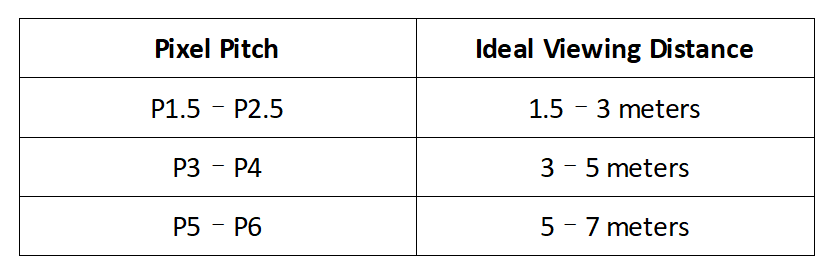
Pixel pitch is the center-to-center distance between adjacent pixels, measured in millimeters. Smaller pitch increases pixel density at a given screen size. However, a pitch label does not specify how large text will appear, and a simple “pitch in millimeters equals distance in meters” shortcut is not a guarantee that pixels disappear.
Viewing comfort and the distance where individual pixels become indistinguishable are different criteria. There is no universal minimum viewing distance for a pitch label: eyesight, image detail, text size, and brightness all affect the result. Compare candidate panels with your smallest text at the nearest viewing position before approving a configuration.
| Pixel pitch | Calculated native resolution | Pixels per square meter |
|---|---|---|
| P1.25 | 3840 × 2160 | 640,000 |
| P1.5 | 3200 × 1800 | 444,444 |
| P2 | 2400 × 1350 | 250,000 |
| P2.5 | 1920 × 1080 | 160,000 |
| P3 | 1600 × 900 | 111,111 |
These are mathematical examples, not available cabinet configurations or viewing-distance guarantees. Width in pixels equals active width in millimeters divided by pitch; height follows the same formula. Confirm the actual module grid before finalizing dimensions. An indoor LED screen accepting a 4K input is not necessarily a native 4K display.
02. Brightness, contrast, and viewing angle
One nit equals one candela per square meter. Specify useful brightness at the installation location, including dimming quality, instead of assuming every indoor LED screen needs the same output. For example, HonghaiLED’s HH640F2 specifications list SMD options at 600–800 cd/m² depending on pitch. Those product values demonstrate why a universal 800–1,500-nit requirement is misleading.
Check grayscale, skin tones, and uniformity at your intended operating brightness. Room reflections can raise the apparent black level even when pixels are off. View the screen from the outermost seats: a stated viewing angle does not ensure identical color or contrast at every position.
03. Refresh rate, cameras, and processing
LED refresh rate and video frame rate describe different processes. A 60 fps source and a panel rated at 3,840 Hz are not competing specifications. An indoor LED screen must support the required input format, pixel load, grayscale performance, and signal routing as a complete system.
A high advertised refresh rate does not guarantee clean camera footage. Shutter timing, scan behavior, brightness, synchronization, and camera settings can still produce artifacts. Confirm the processor’s camera-timing capabilities and test the complete signal chain. Test the proposed panel and processor with the actual camera settings before accepting a filmed installation.
For presentations, also test laptop switching, scaling, readable spreadsheets, audio synchronization, and recovery after a signal interruption. Ask for a signal diagram and capacity calculation for the selected processor, rather than relying solely on a resolution logo.
4. Indoor LED Screen Applications and Benefits
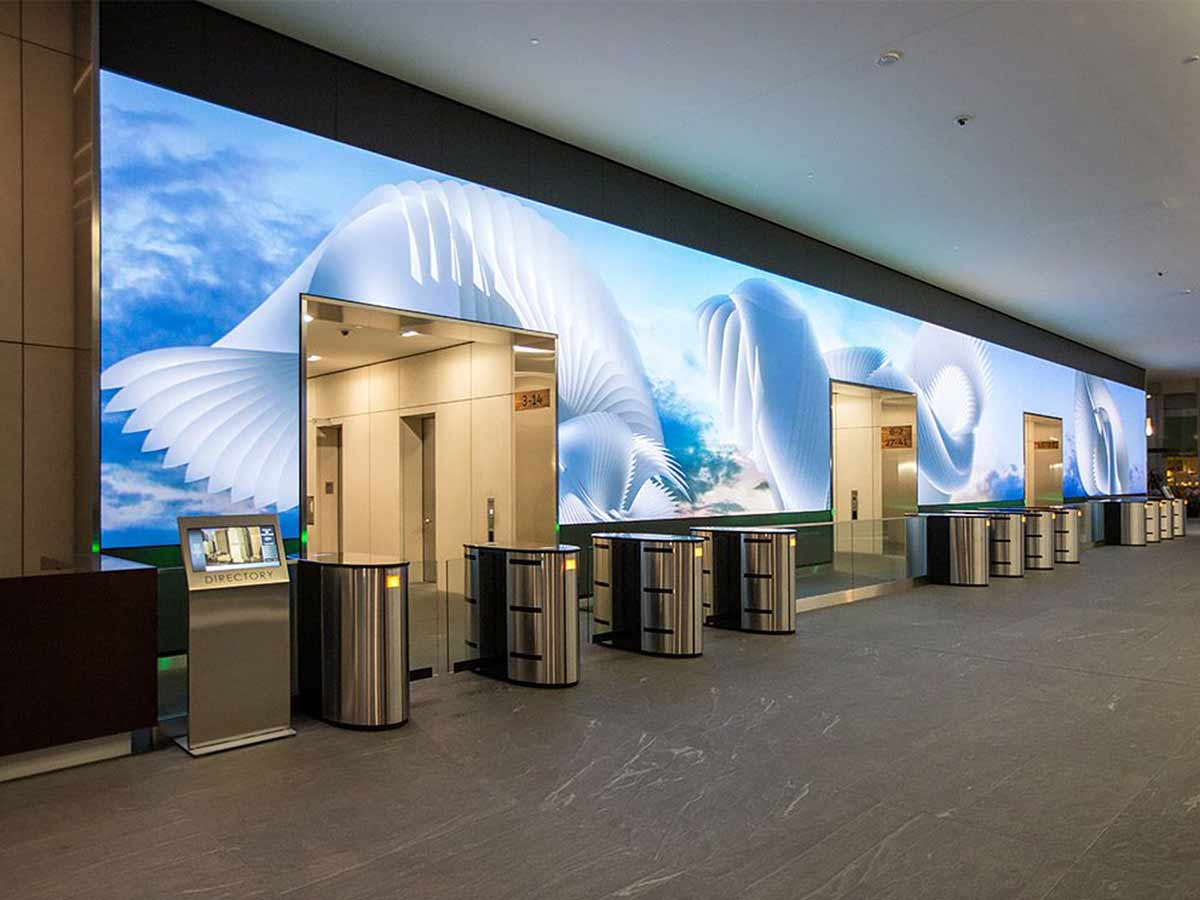
An indoor LED screen can create a large image without the repeated panel bezels of a tiled LCD wall. Modular construction allows project-specific dimensions and replacement of individual components. These advantages are valuable in auditoriums, showrooms, and branded reception areas where a standard television shape is restrictive.
Content can change between presentations, product information, and scheduled announcements. That flexibility depends on the connected player or content-management system; scheduling and remote control are not automatic properties of every indoor LED screen. Define who will prepare, approve, and operate the content.
Compare alternatives honestly. A commercial LCD may offer sufficient detail at a smaller size and simpler installation. Projection may suit a controlled-light room with a suitable throw distance. An indoor LED display becomes compelling when scale, shape, ambient-light performance, or modular service provides a clear operational benefit.
Do not convert a component lifespan claim directly into a guaranteed system life. Power supplies, fans where fitted, controllers, and connectors also require support. Ask about warranty terms, replacement availability, and calibration after repairs when assessing long-term value.
Indoor LED displays for retail stores
For a retail interior, evaluate the screen from the customer walkway and under normal shop lighting. Use bold product visuals and readable prices; a large video wall is less useful if shoppers cannot understand the offer. A glass-facing display also needs a daylight assessment and an explicit decision about transparency versus solid image coverage.
Plan content scheduling, who updates promotions, and access for service outside trading hours. Keep installation clear of entrances, circulation routes, and required signage. Compare indoor display solutions with transparent LED screen options before selecting the storefront format.
Meeting rooms, auditoriums, and events
Meeting rooms need readable slides and spreadsheets at the closest seat; auditoriums require a clear view from the back and sides. Events add transport, assembly, and camera requirements. Use the same sample content across proposals so the chosen system solves the application instead of merely offering the smallest pitch.
5. Installation and Maintenance Suggestions
01. Survey the room and plan service access
Before purchasing an indoor LED screen, record the available wall area, finished floor level, viewing positions, daylight exposure, door dimensions, and delivery route. Confirm whether the screen must sit flush with surrounding finishes. Reserve working space for the technician and the tools needed to remove components.
The mounting design must account for the complete installed assembly, including cabinets, brackets, cabling, and any maintenance arrangement. Have appropriately qualified installers assess the structure and electrical design for the site. Supplier drawings should identify fixing points, alignment tolerances, ventilation clearances, and access requirements.
02. Commission the indoor LED screen as a system
Acceptance should include solid colors, gray ramps, fine text, moving video, and your own presentation files. Look for visible seams, misaligned cabinets, color differences, dead pixels, and unstable signals. Agree the defect criteria and test conditions before delivery so both sides judge the same result.
Measure or document operating brightness, the selected calibration profile, and representative power draw. Verify source switching and any agreed backup signal path. Keep configuration files, receiving-card settings, cabinet mapping, and the bill of materials with the handover documents.
03. Maintain modules, cooling, and configuration
Follow the manufacturer’s cleaning procedure and isolate equipment as required before service. Avoid improvised solvents, pressure washing, or force on exposed LEDs. Inspect ventilation openings, connectors, and mounting points on a schedule appropriate to dust levels and operating hours.
Order agreed spare modules and critical electronics with the indoor LED screen, identifying compatible batches and calibration data. A replacement module may need adjustment to match an aged wall. Confirm who performs repairs, expected turnaround, and shipping responsibilities through the applicable service and warranty terms.
6. Indoor LED Screen Price and Total Project Cost
01. Factors affecting LED screen price
The main cost factors are active area, pixel pitch, packaging, cabinet construction, processing, installation, and support. Halving pitch increases pixel density by approximately four times at the same area, but it does not establish a fixed price multiplier. Manufacturing yield and the complete product design also affect the quotation.
Compare an indoor LED screen price per square meter only after matching the specifications and commercial terms. A panel-only factory quotation cannot be compared directly with an installed local package. Request the currency, delivery terms, validity period, taxes, freight, commissioning scope, and exclusions in writing.
| Cost item | Required detail | Common omission to check |
|---|---|---|
| Display hardware | Area, pitch, native pixels, cabinet quantity, packaging | Spare modules and matching calibration data |
| Control system | Processor, receiving cards, input formats, pixel capacity | Source switching, media player, redundancy |
| Mounting and installation | Frame, brackets, labor, access equipment, finishing | Structural assessment and wall preparation |
| Power and cooling | Maximum load, distribution, cabling, ventilation plan | Building electrical work and cooling upgrades |
| Delivery and support | Packing, freight, duties, commissioning, warranty | Travel, return shipping, training, response time |
02. Calculate ownership cost with explicit assumptions
Use this structure: project cost = display hardware + control equipment + mounting + electrical work + installation + delivery/taxes + agreed spares. Keep an allowance for site-specific work until the survey is complete. Ask each supplier to explain any exclusion instead of filling gaps with assumed market prices.
For operating cost, multiply measured average kilowatts by daily hours, annual operating days, and the local electricity tariff. As an illustration only, a 12 m² indoor LED screen averaging 150 W/m² uses 1.8 kW. At 10 hours per day and 300 days per year, consumption is 5,400 kWh. At an assumed $0.15/kWh, the display electricity cost is $810 annually, excluding cooling and other equipment.
This example is not an HonghaiLED power rating or a quotation. Average consumption changes with content and brightness; electrical circuit design must use the specified maximum load and relevant installation requirements. Obtain the actual product figures and test conditions before estimating payback.
7. Indoor LED Display Technology Trends and Future Planning
01. Compare SMD, COB, and protective coatings
Technology labels should lead to verifiable questions. SMD uses packaged LEDs mounted on the module; COB places chips directly on a substrate with an encapsulation system. GOB commonly describes a protective coating applied over an LED module. These terms alone do not guarantee better contrast, lower power, or easier repair.
For an indoor LED screen within public reach, compare surface protection, cleaning instructions, repair procedures, and sample appearance under room lights. For close-view applications, examine low-gray detail and uniformity alongside pitch. Ask suppliers to demonstrate the exact production configuration being quoted.
02. How to future-proof an indoor LED screen setup
Future planning is more useful than chasing a year-specific feature list. Preserve the indoor LED screen configuration, confirm spare-part availability, and document the processor’s supported inputs and loading limits. Leave agreed space and cable routes for service or planned expansion.
Adding cabinets later may be constrained by component availability, aging, calibration, and controller capacity. If expansion is likely, request a documented plan before purchase. Compare energy performance at equal brightness and content, and evaluate remote monitoring only when it fits your team’s maintenance workflow.
First-party specification example: HonghaiLED HH640F2
The HH640F2 product specifications provide a concrete example of a fixed indoor cabinet: 640 × 480 mm dimensions, 60 mm cabinet depth, and 7.5 kg cabinet weight. The page lists front access to modules, power supplies, and receiving cards, with SMD pitches from P1.25 to P4 and COB options from P1.25 to P1.86.
A four-cabinet-wide, three-cabinet-high layout calculates to 2560 × 1440 mm using 12 cabinets. Cabinet weight alone totals 90 kg, before mounting, cables, and accessories. These are model-specific specifications and layout calculations, not a structural design or a recommendation for every room; confirm the exact configuration and installed load in your quotation.
8. Indoor LED Screen FAQ
01. What is the best indoor LED screen for a meeting room?
The best indoor LED screen makes the smallest required text readable from every seat while fitting the room, budget, and service arrangement. Compare fine-pitch fixed or all-in-one options using your own slides and spreadsheets. Check native resolution, operating brightness, source switching, and access before choosing a model.
02. Is P2.5 suitable for an indoor LED screen?
P2.5 can suit many larger indoor displays, but suitability depends on screen dimensions, audience distance, and content. A 4.8 m × 2.7 m active area at exactly 2.5 mm pitch calculates to 1920 × 1080 pixels. Test small text and faces at the closest seat before approving that configuration.
03. How much does an indoor LED screen cost?
There is no single price without a defined size, pitch, cabinet design, control system, and installation scope. Request an itemized quotation for the complete indoor LED screen project. Separate panel cost from mounting, electrical work, freight, taxes, commissioning, and support to avoid comparing different packages.
04. Can an indoor LED screen be used outdoors?
Only if the manufacturer explicitly specifies the product for those conditions. Standard indoor equipment should not be assumed suitable for rain, direct sunlight, condensation, or exposed connectors. A sheltered or window-facing position still needs an environmental and brightness assessment.
05. Does a higher refresh rate eliminate camera flicker?
No. A high refresh specification is useful, but camera shutter timing, panel scanning, brightness, and synchronization also matter. Test the indoor LED screen with the intended cameras and settings. Include footage acceptance in the project specification if the installation will be filmed.
06.What types of indoor LED display screens are available?
Installation formats include fixed walls, rental cabinets, transparent displays, flexible or curved screens, and all-in-one systems. Fine pitch describes pixel spacing; SMD, COB, and GOB describe packaging or protection. These categories overlap, so specify installation format, pitch, and packaging separately.
07.How do I choose an indoor LED display for a retail store?
Start with the customer viewing distance, ambient light, content, available space, and maintenance access. Test actual product graphics and prices from the walkway. Compare solid and transparent formats for glass-facing installations, and include content scheduling and service access in the project scope.
08.What should I send when requesting a quotation?
Send active width and height, closest and farthest viewers, sample content, indoor lighting conditions, operating hours, service access, installation location, and camera requirements. Include the budget scope and delivery schedule. These details help suppliers propose comparable indoor LED screen systems.
9. Conclusion: Specify the Complete Indoor LED Screen
A successful indoor LED screen purchase balances image detail, room conditions, maintainability, and total cost. Compare the installation format first, calculate the native pixel grid, and validate the result with real content. Treat brightness, contrast, and refresh figures as testable specifications rather than stand-alone quality claims.
Explore HonghaiLED’s indoor display solutions, then request a project-specific recommendation with your dimensions and viewing requirements. An itemized proposal and clear acceptance checklist make the final indoor LED screen easier to install, operate, and support.
About this guide: Published by HonghaiLED, a manufacturer of indoor, outdoor, rental, and specialty LED displays. This guide uses the linked product specifications and explicitly labeled calculations to support purchasing decisions. Product values depend on configuration; final requirements should be confirmed against the project quotation and site survey.
Related Posts
What Type of Backlight Is Used in an LED Display?
An LED-backlit LCD TV or monitor uses edge-lit or direct-lit…
Indoor vs Outdoor LED Displays: Differences & Price
The main differences between indoor and outdoor LED displays are…
LED Display Resolution: 2K, 4K, HD & Pixel Pitch
LED display resolution is the number of physical pixels across…

No Comments