
3D Billboard Guide: Examples, Technology & Costs
A 3D Billboard is usually a large LED screen that uses anamorphic animation, forced perspective, and a precisely chosen viewing point to make flat content appear to have depth. Viewers do not need glasses. For advertisers, the critical decision is not simply whether the effect looks impressive; it is whether the site geometry, screen specification, creative concept, media schedule, and measurement plan work together.
Costs fall into three separate buckets: media placement, 3D content production, and, for owners, the LED system plus installation. A public production benchmark starts at US$2,000-US$4,000 for a simple scene, while even a small share of a Times Square screen starts at US$150 per day. A permanent installation requires a custom engineering quote. This guide explains how the technology works, what proven campaigns teach us, and how to build a realistic budget.
Key takeaways
- The effect is an optical illusion rendered for a defined “sweet spot,” not a hologram.
- Screen geometry and camera perspective must be measured before animation begins.
- A corner or curved display, high brightness, reliable playback, and precise calibration improve the result.
- Separate media, creative, hardware, structure, power, approvals, and maintenance in every budget.
- Judge success through verified audience delivery, attention, brand lift, social amplification, and business outcomes.
Table of Contents
- 1. What Is a 3D Billboard?
- 2. How Does 3D Billboard Technology Work?
- 3. What Hardware Does a 3D Billboard Need?
- 4. 3D Billboard Advertising Examples
- 5. How Much Does a 3D Billboard Cost?
- 6. How to Plan a 3D Billboard Campaign
- 7. Common Mistakes to Avoid
- 8. How to Choose an LED Display Solution
- 9. Frequently Asked Questions
- 10. Conclusion
1. What Is a 3D Billboard?
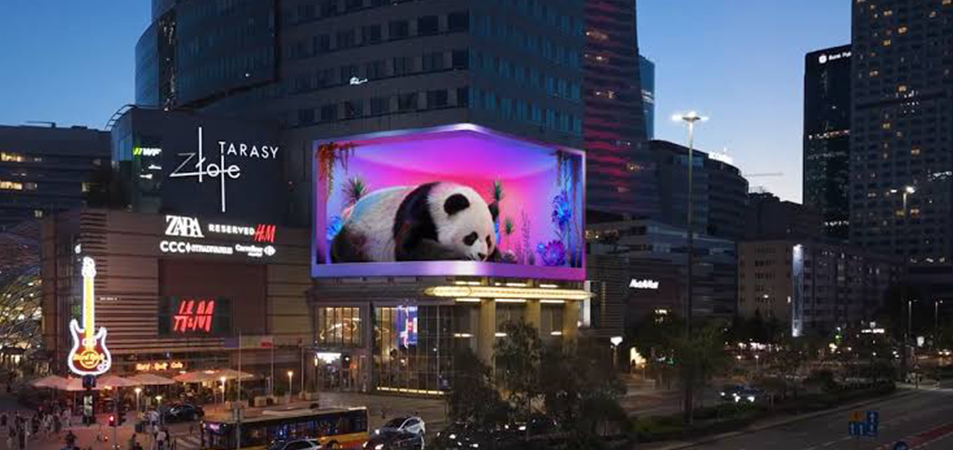
A 3D Billboard is a digital out-of-home display that creates an apparent three-dimensional scene on a two-dimensional LED canvas. Most installations use anamorphosis: the content is intentionally distorted so that it appears correctly proportioned from one planned viewpoint. The result may look like a tiger breaking through a wall, a product floating beyond the frame, or a room extending behind the building.
The terms anamorphic 3D billboard, naked-eye 3D display, and glasses-free 3D billboard are often used interchangeably. They usually describe a perspective illusion, not a stereoscopic display that sends a different image to each eye.
1.1 3D Billboard vs. Traditional Digital Billboard
| Feature | Traditional digital billboard | 3D Billboard |
|---|---|---|
| Primary content | Flat video, images, text | Site-specific anamorphic CGI |
| Ideal screen | Flat rectangle | Corner, curved, wraparound, or carefully framed flat screen |
| Viewing area | Broad | Strongest within a planned viewing zone |
| Production workflow | Standard motion design | 3D modeling, virtual camera setup, rendering, compositing, on-site test |
| Main strength | Reach and message frequency | Attention, spectacle, product demonstration, social sharing |
| Main risk | Creative may be ignored | Illusion can fail outside the sweet spot or on poor-quality recordings |
1.2 When the Format Makes Sense
Use a 3D Billboard when a launch, entertainment release, destination, or flagship product has one visual idea that can be understood in seconds. Busy pedestrian plazas, retail districts, transport hubs, and building corners with predictable viewing positions are strong candidates. Choose conventional digital out-of-home when the message needs detailed copy, viewers pass at highway speed, or the screen is seen from widely separated angles.
2. How Does 3D Billboard Technology Work?
The short answer to “how do 3D billboards work?” is: a 3D scene is rendered from a virtual camera that matches a real viewer’s position. When the distorted image is shown on the LED facade, perspective lines, shadows, foreground occlusion, and frame-breaking motion combine into a convincing depth illusion.
2.1 Site Survey and the Viewing Sweet Spot
Production starts with the physical site, not the animation. The team records the screen’s width, height, resolution, curvature or corner angle, elevation, orientation, and surrounding architecture. It then chooses the primary viewing zone, such as a pedestrian plaza or opposite sidewalk.
Coper’s production workflow describes the same sequence: scan the screen and location, build an accurately proportioned screen model, position the virtual camera at the viewer’s location, and apply forced perspective. The illusion remains visible outside that point, but depth and proportions become less convincing as the viewer moves away from it.
2.2 Virtual Box, Camera and Forced Perspective
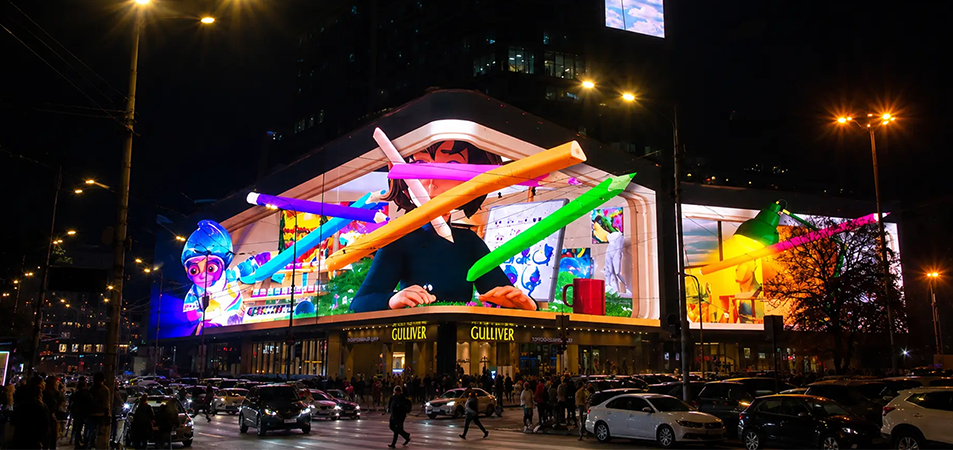
Artists commonly create a virtual “box” behind the screen. Its walls, ceiling, and floor supply familiar depth cues. Objects can then move behind the apparent frame, cast shadows onto the box, approach the virtual camera, or seem to cross the screen boundary.
The render camera stays locked to the chosen real-world viewpoint. A generic 16:9 animation stretched across a corner will not create the same effect; successful 3D Billboard creative is calibrated to its site.
2.3 Rendering, Playback and Calibration
The finished scene is rendered to the exact pixel map and media-owner specification. The controller must synchronize every cabinet and screen face, while sufficient bit depth and clean frame pacing prevent banding and uneven motion. On-site testing from the sweet spot and secondary approaches verifies seams, perspective, brightness, color, daylight visibility, and smartphone recording.
3. What Hardware Does a 3D Billboard Need?
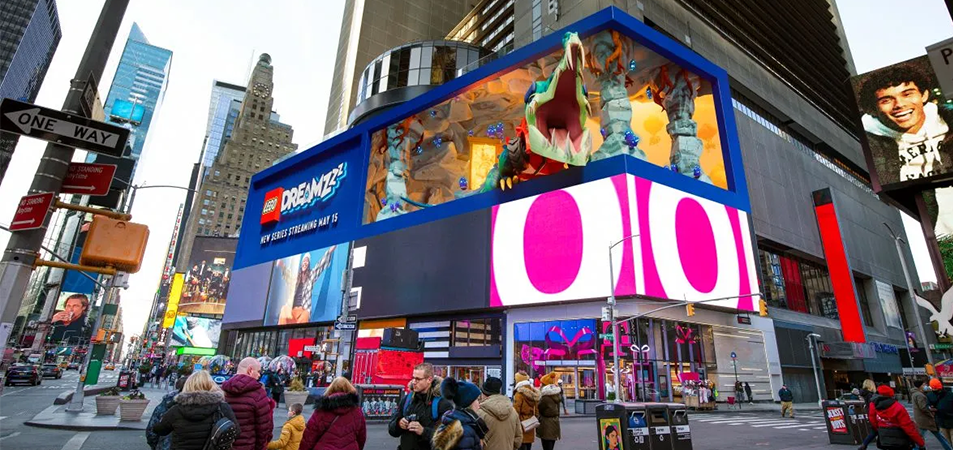
The 3D Billboard effect is produced by content, but weak display hardware can break it. Buyers should treat LED specifications as a system: pixel pitch, brightness, refresh rate, grayscale performance, cabinet geometry, protection, structural engineering, control, power, and service access all affect the final image.
3.1 Screen Geometry
A 90-degree outside corner is popular because two LED faces suggest an architectural volume. Curved, wraparound, and flat screens also work when content is mapped to their real dimensions and viewpoint.
For example, HonghaiLED’s HH960F3 outdoor LED billboard can be customized with a 90-degree corner cabinet for naked-eye 3D applications. Its 960 x 960 x 77 mm cabinet, front-and-rear service design, and IP65 protection illustrate the type of installation and maintenance details that matter in a permanent outdoor system.
3.2 Pixel Pitch, Brightness and Refresh Rate
Pixel pitch should be selected from the closest important viewing distance, not from screen size alone. A tighter pitch supports closer viewing and fine product detail but increases LED count, processing load, and price. The official Cross Shinjuku Vision site specifies a 6 mm SMD LED screen, showing that a landmark outdoor installation can prioritize scale and viewing distance rather than indoor-style fine pitch.
Outdoor brightness must overcome ambient light. HonghaiLED’s outdoor LED display guide gives a typical range of 5,000-10,000 nits and recommends weather protection such as IP65 or IP67. Automatic brightness control is still important: maximum output at night can reduce comfort, waste energy, and conflict with local rules.
Refresh rate matters because campaign reach often extends through phones. Test the actual cabinet and controller with common phone cameras; a screen that looks stable to the eye may still show scan lines or flicker.
3.3 Control, Redundancy and Maintenance
A commercial 3D Billboard should support exact pixel mapping, scheduling, remote monitoring, brightness management, fault alerts, and appropriate signal or power redundancy. Specify front or rear service access, spare modules, receiving cards, power supplies, calibration files, and a documented replacement procedure.
4. 3D Billboard Advertising Examples
The best 3D Billboard advertising examples are useful because each demonstrates a different strategic model: an always-on character that becomes a destination, a launch campaign deployed across cities, or a physical screen that creates real depth.
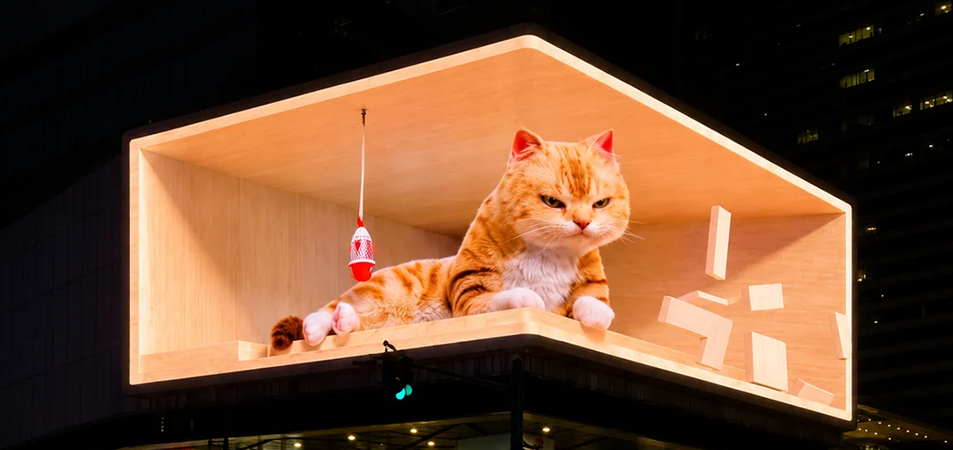
4.1 Cross Shinjuku Vision’s Giant Cat
The Shinjuku East Exit Cat appeared in July 2021 and helped turn Cross Shinjuku Vision into a recognizable destination. The official site says the display runs from 07:00 to 25:00, an 18-hour daily schedule, with silent broadcasts after midnight. The cat works because the character, virtual room, motion, and corner geometry can be understood without explanatory copy.
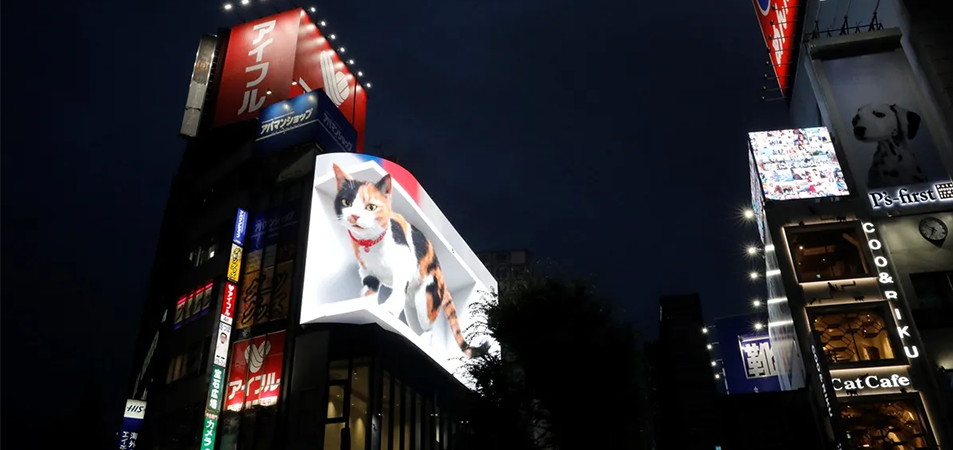
Lesson: recurring character content can build an identity for the location. Small behaviors and eye contact may be more memorable than constant visual explosions.
4.2 Samsung “Tiger in the City”
Ahead of Galaxy Unpacked 2022, Samsung placed a giant 3D tiger in five cities: New York, London, Dubai, Kuala Lumpur, and Seoul. The tiger breaking through a digital barrier translated the product’s low-light photography message into one visual idea.
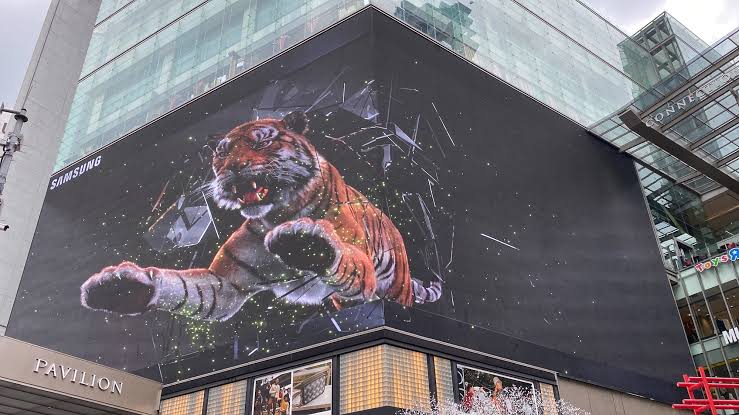
Lesson: make the spectacle dramatize a product benefit instead of placing unrelated entertainment beside a logo.
4.3 Coca-Cola’s Mechanical Times Square Display
Coca-Cola took a different route: physical movement rather than only anamorphic video. Guinness World Records lists its Times Square installation as the largest 3D robotic billboard at 210.22 m2 (2,262 ft2). It used 1,715 moving and 245 static LED cubes, with each moving cube able to extend 1.52 m. This real surface depth contrasts with perspective-based LED campaigns.
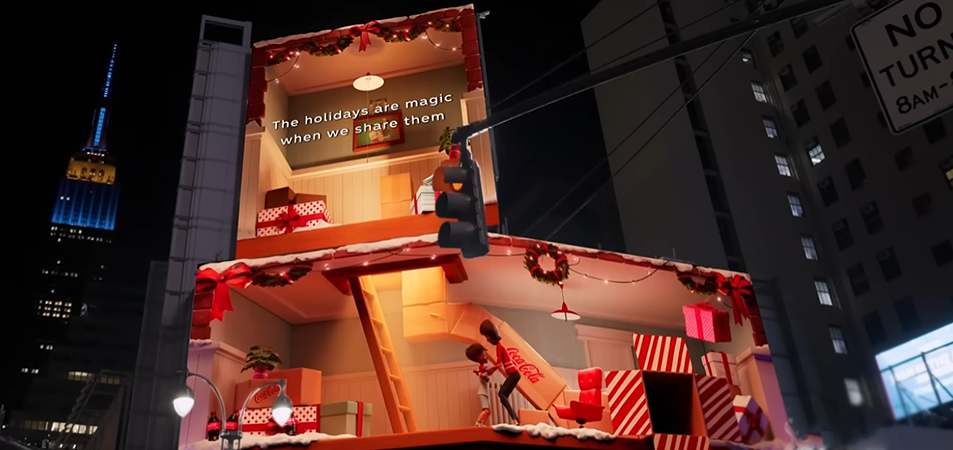
Lesson: specify whether “3D” means anamorphic content, a dimensional screen, mechanical movement, interactive media, or a combination.
4.4 What These Examples Have in Common
| Example | Technical approach | Strategic strength | Transferable lesson |
|---|---|---|---|
| Shinjuku cat | Corner LED plus anamorphic character | Destination and recurring attention | Build recognizable behavior, not only a one-time reveal |
| Samsung tiger | Multi-city anamorphic DOOH | Product launch and global consistency | Turn one product benefit into one visual action |
| Coca-Cola | Mechanical moving display surface | Physical novelty and record value | Define the desired 3D method before budgeting |
5. How Much Does a 3D Billboard Cost?
There is no single 3D Billboard cost because “buying a billboard” can mean renting a few seconds on an existing screen, commissioning custom CGI, or purchasing and installing an entire LED facade. Ask every vendor to separate these layers so that low media-entry prices are not confused with full campaign or ownership costs.
5.1 Public Cost Benchmarks
The following figures are planning references, not universal market averages. They were publicly listed when this guide was updated in August 2026 and can change by location, demand, duration, complexity, and technical scope.
| Cost layer | Public reference | What it includes | What it does not include |
|---|---|---|---|
| Simple 3D content | US$2,000-US$4,000 | 1-2 objects and basic animation | Media, screen, installation |
| Medium 3D content | US$4,000-US$5,000 | Custom model, effects and compositing | Media, screen, installation |
| Complex 3D content | From US$5,000 | Simulations, characters, advanced camera work | Media, screen, installation |
| Entry-level Times Square screen share | From US$150/day | 15 seconds every hour on one 55 x 31 ft screen | Exclusive takeover or custom 3D production |
| Permanent outdoor LED system | Custom quote | Cabinets, modules and control as specified | Often excludes structure, power, permits, content and long-term service unless stated |
The creative ranges come from Coper’s 2025 production menu. The Times Square offer provides 15 seconds per hour on a 55 x 31 ft screen; it is a low-entry media reference, not the price of a premium 3D Billboard takeover.
5.2 Why Media Prices Vary So Widely
Media price depends on screen size, visibility, audience volume, share of voice, loop frequency, daypart, duration, season, and synchronization. The Times Square Alliance lists formats from a 3,685 ft2 ABC SuperSign to more than 13,000 ft2 of synchronized BIG Outdoor signage, with 1.5 million tourists and residents passing through the district daily.
For a defensible 3D digital billboard cost, request the exact screen ID, dimensions, pixel map, loop length, spot length, plays per hour, operating hours, estimated impressions, measurement method, proof-of-play report, and any production surcharge. A low daily rate may buy only a few minutes of total exposure.
5.3 Ownership Costs
Owners must budget beyond LED cabinets. A complete 3D Billboard project can include structural and wind-load engineering, steelwork, electrical distribution, lightning protection, cooling, waterproofing, control and redundancy, permits, lifting, installation, commissioning, spares, content, monitoring, energy, insurance, and calibration.
Use this planning equation:
Total first-year cost = display system + structure/electrical + installation/permits + creative + control/integration + spares + first-year operation
Do not treat a per-square-meter display price as a turnkey total. Give each bidder the same drawings, viewing distances, structural constraints, climate data, service plan, operating hours, and warranty requirements.
6. How to Plan a 3D Billboard Campaign
A high-performing 3D Billboard campaign moves through six gated decisions. Skipping the early site and message work usually creates expensive revisions during rendering or on-site testing.
6.1 Define One Observable Objective
Choose one primary outcome: launch awareness, store visits, ticket sales, app activity, brand lift, or earned social reach. Define the baseline, audience, geography, dates, and measurement window; “go viral” is not a measurable brief.
6.2 Select the Site Before Developing the Final Creative
Request the media kit, pixel map, viewing-zone diagram, codecs, frame rate, luminance limits, safe areas, loop rules, approval lead time, and proof-of-play method. Visit at the intended dayparts to check pedestrian flow, dwell time, sunlight, obstructions, and camera positions.
6.3 Reduce the Story to One Visual Action
The audience should understand one action in a pass: reveal, escape, transformation, interaction, or product demonstration. Keep the logo and call to action readable outside the ideal angle. The 3D Billboard effect should improve comprehension, not delay it.
6.4 Prototype Before Full Rendering
Build a low-resolution animatic in the measured screen model. Approve timing, scale, product accuracy, and brand cues from the sweet spot and secondary viewpoints before expensive rendering.
6.5 Test on the Real Screen
Reserve a technical test slot. Check seams, clipping, flicker, color, perspective, brightness, and legibility by eye and on several phones. Keep time and render capacity for at least one correction round.
6.6 Measure Delivery and Outcome
Collect proof of play and the media owner’s audience methodology. Add QR scans, branded-search lift, footfall, landing-page sessions, social mentions, or an exposed-versus-control brand study. Report paid distribution separately from organic sharing.
7. Common Mistakes to Avoid
7.1 Designing Before Receiving the Pixel Map
Generic content cannot account for the screen’s actual corner, curvature, safe zones, or resolution. Lock the site model and technical template before final animation.
7.2 Optimizing Only for the Sweet Spot
The illusion may be strongest at one point, but most viewers will approach from elsewhere. Make the product, brand, and message understandable from secondary angles and in a flat social crop.
7.3 Using Too Much Copy
Complex perspective plus multiple claims overloads a short viewing window. Keep one idea, one focal object, and one simple action. Move detail to a landing page or retargeting campaign.
7.4 Ignoring Smartphone Capture
Social amplification often depends on clean video. Test refresh performance, moire, exposure, shutter interaction, and portrait framing before launch.
7.5 Comparing Incomplete Quotes
One proposal may include only LED cabinets while another includes structure, control, installation, spares, and service. Normalize every quote against a written scope and five-year operating assumptions.
8. How to Choose an LED Display Solution
For a permanent outdoor 3D Billboard, start with site conditions. Give the supplier screen dimensions, corner or curve geometry, viewing distance, target brightness, climate, structural data, available power, service clearance, operating schedule, and content format.
HonghaiLED’s HH960F3 is relevant where a fixed outdoor, corner-capable system is required. Its configurable 90-degree cabinet, IP65 protection, aluminum construction, and front/rear access address core geometry and service needs. Final pixel pitch, structure, control capacity, and approvals still require project engineering.
Use the following buying checklist:
- Confirm native screen resolution and receive the final pixel map.
- Choose pixel pitch from the closest priority viewing distance.
- Verify calibrated brightness, refresh rate, grayscale, and camera performance.
- Confirm corner seams or curve transitions with a physical sample or project reference.
- Match IP rating, cooling, corrosion protection, and wind-load design to the site.
- Document front/rear service access and module replacement time.
- Specify controller capacity, backups, monitoring, and brightness scheduling.
- Price structure, power, installation, permits, spares, warranty, and maintenance separately.
- Run factory acceptance and on-site acceptance tests with actual 3D Billboard content.
For broader background, review HonghaiLED’s 3D LED display guide, commercial LED display solutions, and guide to 3D billboards in China.
9. Frequently Asked Questions
9.1 How do 3D billboards work without glasses?
They use anamorphic perspective rather than stereoscopic glasses. Artists render a distorted 3D scene from a virtual camera aligned with a real viewing point. When the LED screen displays that image, depth cues make it appear dimensional from the intended zone.
9.2 Does a 3D Billboard need a curved screen?
No. A flat screen can create an anamorphic effect, but a corner, curve, or wraparound facade gives artists stronger architectural cues and can improve the sense of volume. The content must always match the real screen geometry.
9.3 How much does a 3D Billboard cost?
For rented media, budget separately for the playback slot and custom creative. One production company publicly lists simple content at US$2,000-US$4,000, medium work at US$4,000-US$5,000, and complex work from US$5,000. Media ranges from fractional screen time to premium takeovers. A permanent LED installation needs a site-specific engineering quote.
9.4 What is the best pixel pitch for a 3D LED billboard?
There is no universal best pitch. Choose it from the closest important viewing distance, screen dimensions, content detail, camera requirements, and budget. Closer pedestrian viewing generally needs a tighter pitch than a facade viewed from across a large plaza.
9.5 Is a 3D Billboard the same as a hologram?
Usually not. Most outdoor campaigns show conventional LED pixels on a flat, corner, or curved surface. The apparent depth comes from perspective and animation. A holographic display uses a different optical process.
9.6 How long does 3D Billboard content take to produce?
Timing depends on modeling, animation, simulation, approvals, rendering, and test access. Schedule site measurement, animatic approval, final rendering, media-owner review, and an on-screen correction round.
10. Conclusion
A 3D Billboard succeeds when media, technology, and creative are designed as one system. Start with the site and viewing zone, reduce the message to one visual action, build the animation against the real pixel map, and test on the installed display. For costs, keep media, CGI, LED hardware, installation, and operations in separate budget lines.
If you are planning a permanent outdoor screen, share your drawings, viewing distances, climate, service access, operating schedule, and content goals with HonghaiLED. That information allows the team to recommend the appropriate cabinet geometry, pixel pitch, protection, control system, and project scope instead of relying on a generic price per square meter.
Related Posts
NovaStar TB60: Full Introduction and User Manual
The NovaStar TB60 represents the pinnacle of multimedia player technology…
NovaStar VX4S LED Controller: Specs, Setup, Manual and FAQs
Quick answer: The NovaStar VX4S is an all-in-one LED display…
NovaStar VX2000 Pro: Specs, Manual, Price & Downloads
The NovaStar VX2000 Pro is NovaStar’s 20-port all-in-one 4K LED…

No Comments