
Rolling LED Screen & Roll-Up LED Display Buying Guide
A rolling LED screen, also called a roll-up LED display or rollable LED screen, is a direct-view LED display designed to roll along a specified path for deployment or storage. Choose it by checking native resolution, approved bending limits, support, operating environment and total system cost. A flexible panel alone does not prove repeated rolling capability.
This buying guide helps event teams, retailers and project buyers compare display formats, assess rolling LED screen price quotations and plan installation. The terms rolling LED display and roller LED screen can describe different mechanisms, so confirm the exact model and deployment method before ordering.
- Confirm the format: repeated roll-up operation, fixed curved modules and adhesive transparent film are different requirements.
- Compare complete systems: include the mechanism, support, controller, power equipment, cases and delivery in each quotation.
- Test your content: pixel pitch, viewing distance, venue lighting and camera settings matter more than an input-resolution label.
Guide updated: October 9, 2026. Product examples link to HonghaiLED’s published information; confirm the final model specifications in your quotation.
1. What Is a Rolling LED Screen?
A rolling LED screen combines an LED image surface with a mechanical design that permits controlled rolling. Depending on the product, that surface may use flexible modules or connected sections that move relative to one another. A support, suspension arrangement or base holds the deployed display in its operating position. A motorized roller is an option on some systems, not a defining feature of every rollable LED display.
The LEDs emit the image directly, so no projector or projection fabric is required. This commercial display category should not be confused with a rollable OLED television. It also differs from a rigid screen on wheels: wheels describe how the stand moves, while rollability describes movement of the screen assembly itself.
01. Flexible, foldable and rollable mean different things
A flexible LED module can follow a curved support within its approved bending range. That does not establish that it can survive repeated winding onto a drum. A foldable display closes at designed hinges; folding across another location may damage it. A retractable rolling LED screen needs a defined storage path, cable management and controls appropriate to that mechanism.
Before ordering, ask for a demonstration of the exact proposed model being packed, deployed and operated. Obtain its minimum bend radius, permitted bending axis and rolling direction in writing. A still photograph of a curved module proves shape flexibility, but it does not establish the complete system’s rolling-cycle durability.
| Format | Typical requirement | What must be confirmed |
|---|---|---|
| Roll-up LED display | Repeated deployment and packing for events or a retractable installation. | Complete mechanism, minimum bend radius, rolling direction, tested cycle conditions and cable routing. |
| Flexible LED panel | A fixed curved wall, cylinder or custom shape. | Approved curvature, supporting structure and access for module replacement; flexibility does not prove roll-up endurance. |
| Transparent LED film | Advertising on glass while preserving a view through the installation. | Adhesive application, glass suitability, transparency and indoor/outdoor limits for the specific product. |
| Foldable or wheeled LED poster | A portable sign that folds at hinges or moves on a stand. | Actual folding geometry, packed size and stability; wheels do not make the display surface rollable. |
02. Understand the flexible-film examples on this page
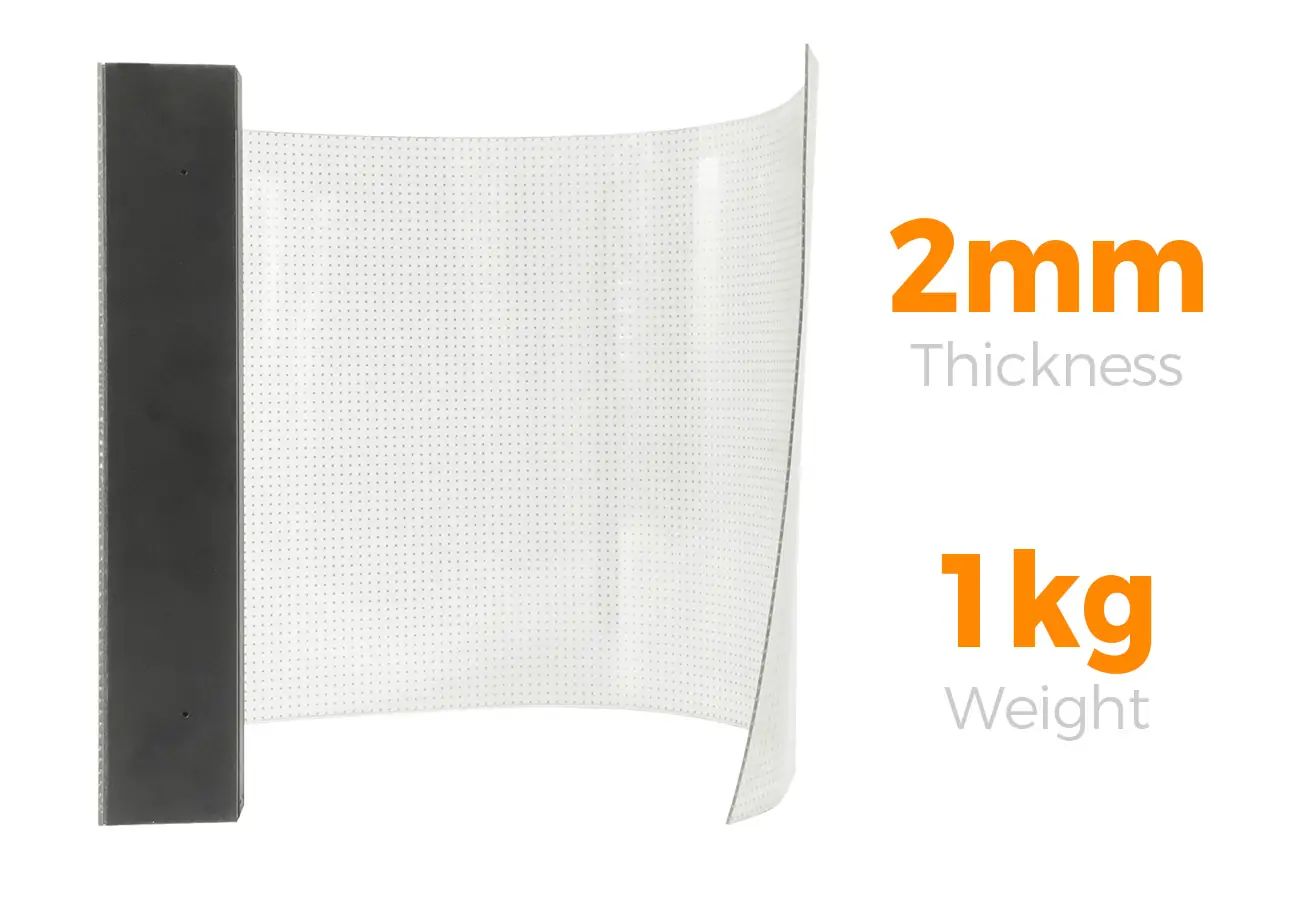
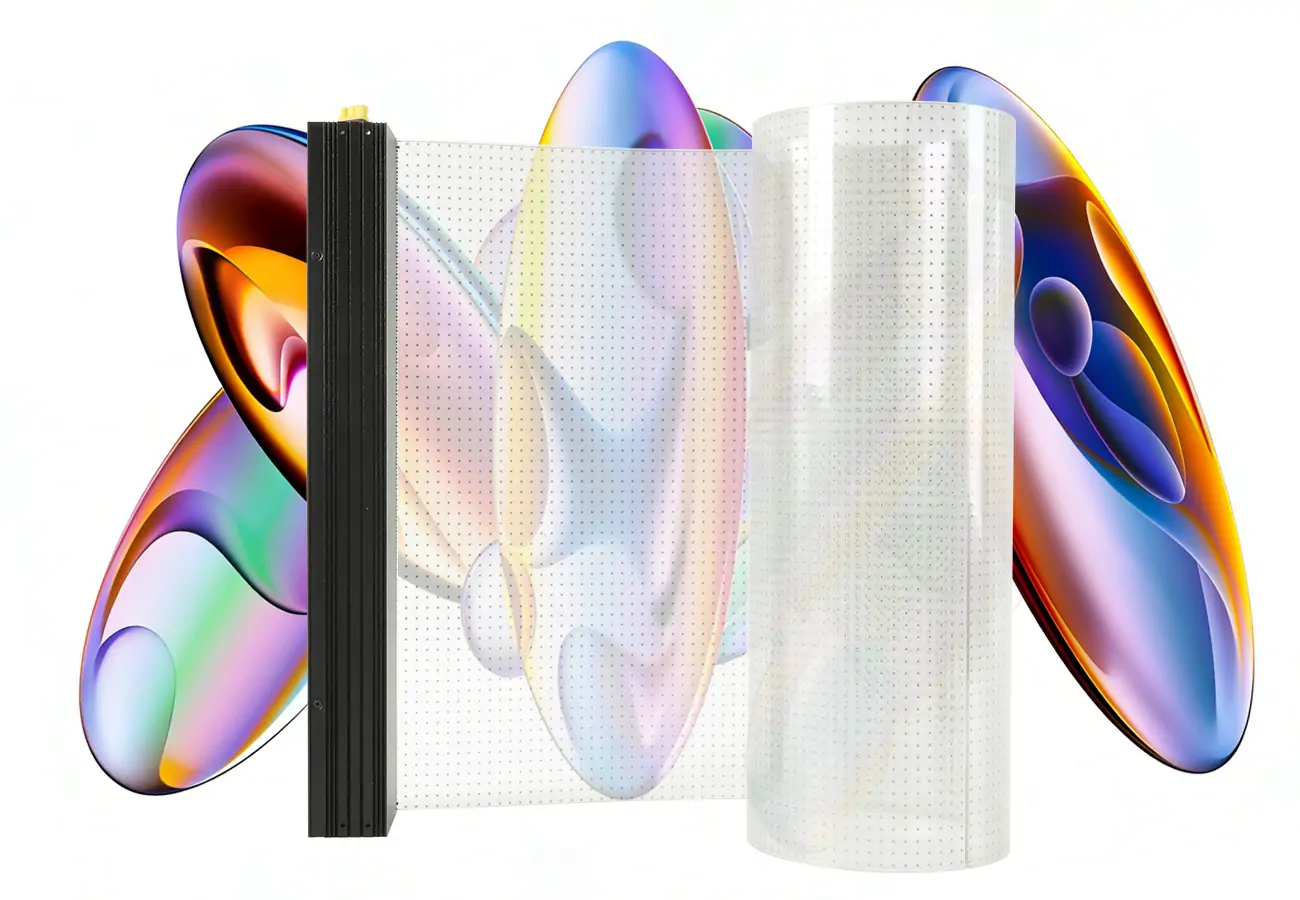
The retained images and video illustrate related flexible-display formats. HonghaiLED’s EA-iFilm2 flexible film LED display is described as a self-adhesive product for glass installations. Its flexibility should not be interpreted as proof of a reusable retractable mechanism. For a permanent curved wall, EA-Flex soft LED modules represent another category to investigate.
Describe whether you need a screen that rolls between events, a display that retracts daily, or a panel installed once on a curved surface. This distinction prevents a quotation for a flexible component from being mistaken for a complete rolling LED screen.
2. Roll Up LED Screen Benefits and Applications
The strongest reason to choose a rolling LED screen is a measurable improvement in deployment or storage for your actual venue. Flexibility alone does not guarantee lower cost, better durability or faster installation. Compare the packaged system, including its stand, roller, power equipment, controller and protective case.
01. Transport, storage and repeated events
A roll up LED screen can reduce the volume occupied by the display surface when packed. The practical benefit depends on the housing and transport case, which may determine vehicle size more than panel thickness does. Ask for packed dimensions, gross weight, lifting points and the number of people required for safe handling.
For exhibitions and touring presentations, measure setup from unloading to a correctly mapped image. Include positioning, securing the support, connecting power, configuring the controller and testing content. A short motor-extension demonstration does not represent total installation time. Request a timed demonstration using the same accessories and screen size as your order.
02. Retail, exhibitions and creative layouts
A rolling LED screen can support temporary branding, product demonstrations and reusable exhibition backdrops. Check the audience’s nearest position and the size of the smallest text. A large, bright image can attract attention while still making a price label or product specification difficult to read if pixel pitch is too coarse.
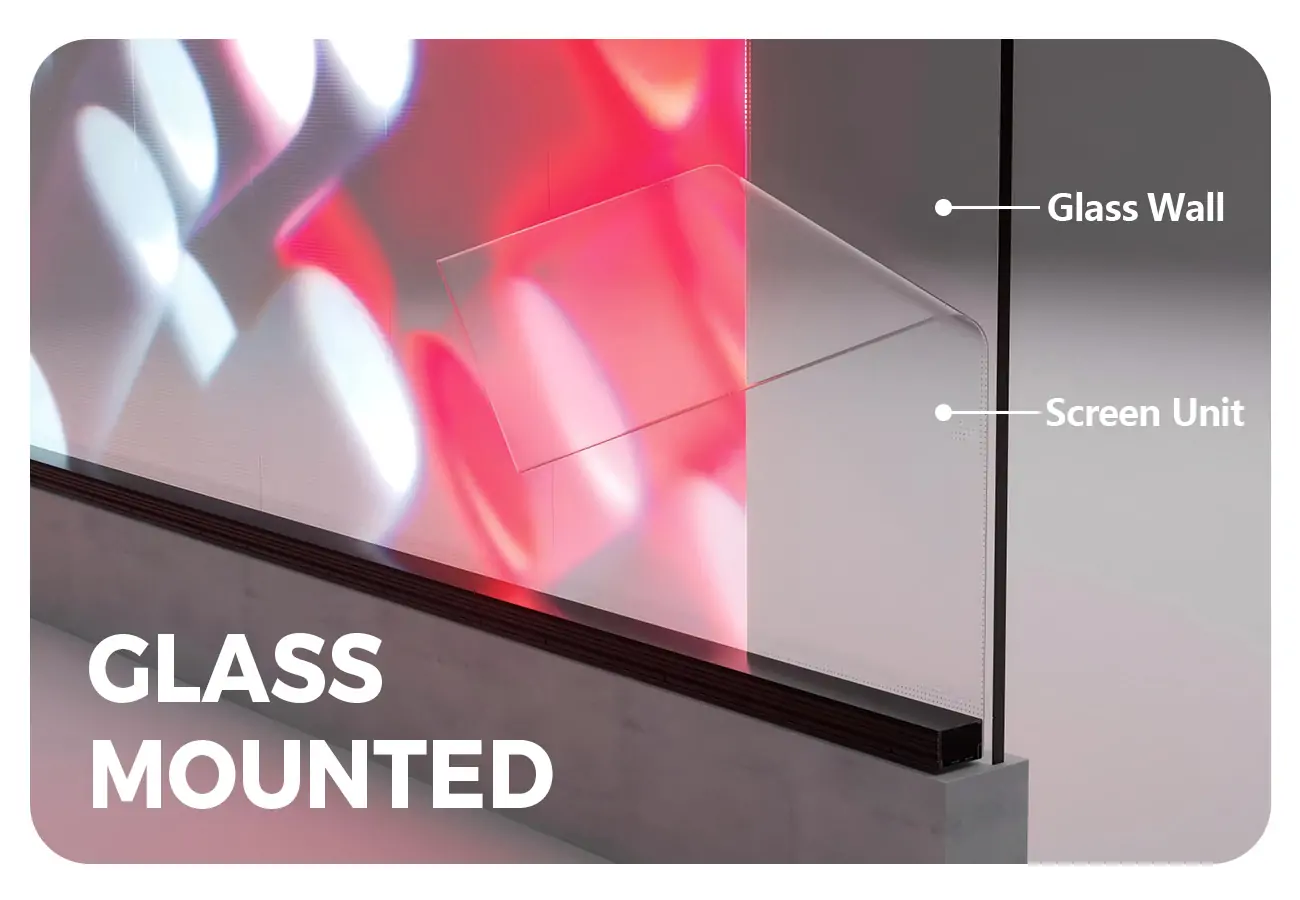
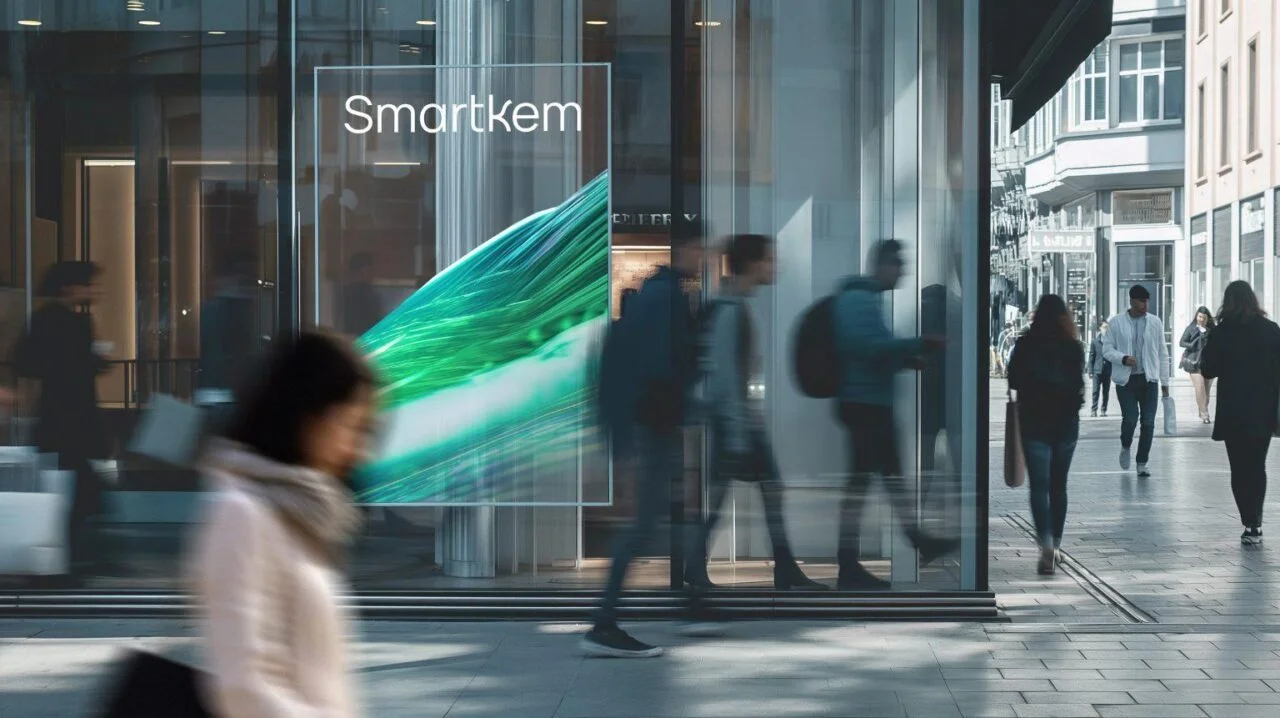
For glass storefronts, decide whether transparency is essential. Transparent film and an opaque rollable LED display serve different visual goals. Assess reflections, daylight, the view through the glass and visibility from both sides before selecting either. Show the supplier photographs taken at the brightest time of day, alongside the proposed mounting location.
03. Where the benefits may not justify the complexity
A permanent flat wall may benefit more from standard cabinets, accessible service parts and a simple support structure. A rolling LED screen introduces movement that must be managed throughout its life. Motors, guides, flexible interconnects and tensioning components, where fitted, add inspection requirements beyond those of the LED image surface.
Consider rental instead of purchase for infrequent events. For regular deployments, compare total annual handling, storage, repair and transport costs. Do not assume a universal percentage saving: venue access, crew rates, journey length and the design of the alternative LED wall can change the result substantially.
3. How Does a Rolling LED Display Work?
A rolling LED screen has two cooperating systems: electronics that create the picture and mechanics that support controlled movement. Both must function within the manufacturer’s limits. Good image specifications cannot compensate for an unsuitable winding mechanism, and convenient packing cannot compensate for poor image quality.
01. LED modules, protection and bending limits
LED packages and driver components sit on modules connected into a display surface. Flexible substrates or articulated structures permit the intended curvature while carrying electrical connections. Bending places stress on the assembly; approved radius and direction matter because the circuit, coating and connectors may tolerate different amounts of movement.
Some compatible designs use protective encapsulation. GOB LED module protection can help protect the LED face, but coating alone does not establish an outdoor rating or unlimited rolling endurance. Ask whether the chosen coating has been qualified for the proposed movement and how coated modules are repaired.
02. Video processing and content mapping
The source sends content to a processor or media player, and the control system distributes pixel data to receiving electronics and LED drivers. The configured pixel map must match the physical screen. A roll up LED display may accept a high-resolution input while having a much lower native pixel count; input compatibility does not create extra display pixels.
Prepare content for the screen’s actual aspect ratio and resolution. Use readable type, generous spacing and strong contrast. Test small text, gradients and motion at the intended brightness. For live events, verify the full signal route and latency with the cameras, switcher and source equipment you will use.
03. Support, movement and cable routing
The rolling LED screen needs a mechanism or handling procedure that keeps movement within its design envelope. Confirm how the surface stays aligned, how cables move and whether connectors must be disconnected before packing. Do not pull the screen taut or wind it tightly unless the manual explicitly requires that method.
For motorized products, request instructions for travel limits, obstruction response and recovery after power loss. Establish whether operation while moving is permitted. Keep operators clear of moving parts and follow the supplied procedure; a flexible surface can still transmit substantial force through its support.
04. Power, heat and image performance
Power supplies convert the incoming supply to the voltages required by the electronics. Request maximum and typical operating power with their test conditions. Typical consumption depends on content and brightness; circuit planning must use the appropriate specified load and local installation requirements, not an attractive average-energy figure.
Refresh rate describes repeated LED driving, while video frame rate describes incoming pictures per second. They are not interchangeable. For camera-facing use, evaluate scan behavior, brightness settings, shutter settings and synchronization together. A high refresh-rate number alone cannot guarantee freedom from banding or moiré.
4. Rolling LED Screen vs Traditional LED Display: Specifications and Price
Compare a rolling LED screen with an alternative that meets the same visual and operational requirements. A coarse-pitch transparent panel and a fine-pitch opaque rental wall are not equivalent, even if both cover the same area. The table below identifies differences to verify rather than promising that either format always wins.
| Decision factor | Rolling LED screen | Rigid LED cabinet system | What to verify |
|---|---|---|---|
| Mechanical form | Designed for a specified rolling path or packing method. | Rigid cabinets; some allow curved assembly through adjustable connections. | Approved configuration, dimensions and support drawing. |
| Transport | The surface may pack compactly; housing and cases still add volume. | Cabinets travel in cases or racks; weight varies by design. | Total packed volume and gross shipment weight. |
| Setup | Can simplify deployment when support and controls are integrated. | Requires assembly; rental designs may use quick locks. | Full deployment time and required crew. |
| Image quality | Depends on pitch, electronics, alignment and calibration. | Depends on the same visual factors and cabinet alignment. | Actual content viewed at the nearest audience position. |
| Service | May require access to moving components and flexible connections. | Module and power access depends on front or rear service design. | Replacement procedure, spare availability and access space. |
| Outdoor suitability | Must be explicitly specified for the complete configuration. | Indoor and outdoor cabinet variants are available. | Environmental ratings for all exposed components. |
| Ownership cost | Include mechanism upkeep and repeated-handling requirements. | Include assembly labor, cases and structural equipment. | Comparable itemized quotations over the same usage period. |
Explore HonghaiLED’s rental LED display range when modular event cabinets may suit the job. Keeping both options in the comparison makes it easier to justify the chosen format with practical evidence.
01. Choose pixel pitch from content and viewing conditions
Pixel pitch is the center-to-center distance between adjacent pixels, normally expressed in millimeters. Smaller pitch provides more pixels within a given area. For a rolling LED screen showing detailed presentations, assess the smallest text and graphics from the closest seat. For large logos viewed farther away, a coarser pitch may satisfy the task.
Resolution calculation: horizontal pixels ≈ screen width in millimeters ÷ horizontal pitch; vertical pixels ≈ screen height in millimeters ÷ vertical pitch. For example, a hypothetical 3,000 × 2,000 mm display at 2.5 mm pitch contains approximately 1,200 × 800 pixels, or 960,000 pixels. This is a mathematical illustration, not an available model specification.
Final dimensions must fit the actual module layout. Where horizontal and vertical pitch differ, calculate each axis separately. Avoid treating a simple pitch-to-distance rule as a guarantee of readability: eyesight, text size, contrast, ambient light and camera use all affect the result.
For a second calculation, a hypothetical 3,000 × 1,500 mm screen has a 2:1 aspect ratio. The table shows how pitch changes pixel count while physical area stays at 4.5 m². These are calculations, not HonghaiLED model specifications; available sizes must follow the actual module grid.
| Pitch on both axes | Calculated native resolution | Total pixels |
|---|---|---|
| 2.5 mm | 1,200 × 600 | 720,000 |
| 3.0 mm | 1,000 × 500 | 500,000 |
| 5.0 mm | 600 × 300 | 180,000 |
For more selection guidance, see LED pixel pitch and viewing distance. Test the smallest text at the nearest intended audience position before approving a pitch.
02. Request a complete rolling LED screen specification
| Specification | Information to request | Practical acceptance check |
|---|---|---|
| Pitch and pixel count | Pitch on both axes, module resolution and total mapped pixels. | Display native-resolution text and a pixel-mapping test pattern. |
| Brightness and dimming | Rated brightness, operating range and measurement conditions. | Check readability and dark-scene detail under venue lighting. |
| Refresh and camera behavior | Refresh rate, scan mode and supported video timing. | Record the screen with the intended camera settings. |
| Bending and cycling | Minimum radius, direction, cycle-test method and maintenance interval. | Witness approved deployment and packing; review test records. |
| Environmental limits | Complete-system protection rating, temperature and humidity limits. | Match the documentation to each exposed part and installation orientation. |
| Power and cooling | Maximum load, typical load conditions, supply input and ventilation clearances. | Have the site electrical design checked against the specified configuration. |
| Weight and support | Display, mechanism, base and case weights; approved mounting method. | Check transport access and the installed support design. |
| Service and spares | Compatible modules, cables, power supplies, configuration files and repair terms. | Demonstrate replacement access and restoration of the image. |
Attach the agreed checklist to the purchase specification. Record the selected model and configuration revision so a sample demonstration cannot silently substitute for the equipment delivered. Photograph acceptance patterns and retain the controller configuration with the project documents.
03. Compare rolling LED screen price and total cost
A meaningful rolling LED screen price requires the screen area, pitch, operating environment, mechanism, support and delivery scope. A module-only price cannot be compared directly with a working system price. This guide does not assign a universal price range because no like-for-like current quotation has been established for your project.
Ask suppliers to separate the display surface, roller or base, structural accessories, controller, power equipment, cables, cases, spares, commissioning and freight. Confirm currency, quotation validity, shipping terms, taxes and destination charges. Also identify who handles installation and whether training and technical support are included.
For budgeting, use total ownership cost = purchase and delivery + installation + operating and handling costs + maintenance and repairs over your chosen period. Divide that total by expected deployments when comparing event options. Include realistic downtime and replacement access, rather than assuming every scheduled event will produce an identical saving.
04. Rolling LED screen price: request a comparable quotation
There is no single price for every roll-up LED display. The quote must identify what is included. For the 3,000 × 1,500 mm example above, display area is 4.5 m². If a supplier quotes a display-only rate per m², multiply that rate by 4.5, then add every separately priced system item. Do not count an item twice if it is already included in the package.
- Define the display: width, height, pitch, native resolution and indoor or outdoor conditions.
- Define the movement: rolling frequency, approved mechanism, support method and required packed dimensions.
- Itemize the scope: controller, power equipment, cables, roller or base, cases, spares and commissioning.
- Confirm delivery and support: destination, currency, shipping terms, taxes, lead time, warranty and repair access.
Request an HonghaiLED project quotation with those details and a photo or drawing of the site. Ask for the proposed model’s specification and deployment demonstration alongside the price.
5. How to Install and Maintain Roll Up LED Screens
Use the selected rolling LED screen manufacturer’s manual as the controlling procedure. The sequence below is a planning checklist, not a substitute for model-specific instructions or a qualified assessment of the support and electrical installation. A portable display still requires a stable, suitable operating location.
01. Plan the site before delivery
Measure doors, lifts, loading areas and the full deployed envelope, including service clearance. Check floor conditions or approved suspension points, audience access and cable routes. An outdoor rolling LED screen also needs an environmental plan addressing rain exposure, wind, sunlight and temperature within the complete system’s documented limits.
Agree on the source resolution and screen map in advance. Confirm power availability, connector types and control-equipment location with the installation team. Keep emergency routes clear and arrange protection for cables and exposed equipment where people circulate.
02. Deploy and commission the display
- Inspect the shipment. Check the cases, display edges, connectors and mechanism for transport damage before energizing anything. Record discrepancies while packaging and identification labels are available.
- Secure the support. Assemble and position the approved base or mounting system. Follow the specified stability, restraint and loading requirements; do not improvise a suspension point on the screen surface.
- Unroll as instructed. Follow the approved direction and radius. Keep the assembly aligned and stop if resistance, uneven travel or unusual noise appears.
- Connect the system. Follow the prescribed power-isolation and connection sequence. Ensure cables have suitable movement allowance without becoming trapped or carrying mechanical load.
- Load and verify settings. Apply the correct receiving-card configuration and pixel map. Confirm orientation, brightness and image boundaries before testing customer content.
- Record acceptance. Check solid colors, gray levels, gradients, small text and video. Document faults and save the working configuration before handover.
After commissioning a rolling LED screen, demonstrate packing as carefully as deployment. Operators should know how to isolate power, handle a stalled mechanism and identify conditions that require service. Store the instructions where the event team can access them without relying on one technician’s memory.
03. Maintain, troubleshoot and store the screen
Inspect a frequently handled rolling LED screen before and after each deployment. Look for damaged connectors, loose fasteners, coating defects, abnormal alignment and cable wear. Follow the approved cleaning method for the actual surface; a cleaner suitable for glass may damage an LED coating or adhesive layer.
If the image has missing sections, first check source output, mapping and accessible signal connections using the manufacturer’s diagnostic procedure. If a module differs in color, investigate calibration and component compatibility. If movement becomes uneven, stop the mechanism rather than forcing it. Isolate the supply before service as instructed, and leave internal electrical repairs to qualified personnel.
Pack only when the rolling LED screen is in the condition specified by its manual. Do not trap moisture inside a case or crease a flexible surface to make it fit. Secure loose accessories separately, protect connectors, and observe storage temperature and humidity limits. Keep a maintenance log with operating faults, repairs and deployment cycles where required.
6. Rolling LED Screen FAQs
01. How much does a rolling LED screen cost?
Rolling LED screen cost depends on pitch, area, mechanism, support, control equipment and delivery scope. Request a quotation for a complete working configuration. Compare module-only offers separately, and include cases, spares, installation and freight before judging value. A price per square meter is useful only when the included equipment and performance requirements are equivalent.
02. Is every flexible LED display a roll up LED screen?
No. A flexible module may be intended for a fixed curved installation, while a roll up LED screen is designed for a defined rolling operation. Transparent adhesive film is another format. Ask for the specific model’s approved packing method, bend radius and repeated-movement documentation before assuming that a flexible panel can be retracted regularly.
03. Can a rolling LED screen be used outdoors?
Only use a rolling LED screen outdoors when its complete configuration is specified for the conditions. Check the display, connectors, power equipment and mechanism, along with operating temperature and mounting requirements. A protective coating or front-face IP rating alone does not establish suitability for rain, wind or prolonged sunlight at your site.
04. What pixel pitch should I choose for a rollable LED display?
Choose pitch from the closest viewing position, required text size, screen dimensions and content. Calculate native pixels from dimensions and pitch, then inspect representative content. A rollable LED display used for detailed presentations needs a different assessment from a backdrop showing large logos. Request a sample test instead of relying only on a viewing-distance shortcut.
05. How long does a rolling LED screen last?
There is no single service-life figure for every rolling LED screen. LED brightness aging, power electronics, flexible connections and moving components have different limits. Ask for warranty terms, brightness-maintenance criteria, rolling-cycle test conditions and spare-parts support. A quoted LED operating-hour figure does not automatically describe the life of the entire mechanism or guarantee trouble-free use.
06. Can one person install a rolling LED screen?
Some compact systems are designed for limited-crew deployment, but the requirement must be confirmed for the exact size, weight and support method. Include unloading, positioning, electrical connections, mapping and testing when assessing labor. A rolling LED screen that extends quickly may still require additional people or lifting equipment for safe transport and installation.
07. Can a roll up LED screen show live video?
A roll up LED screen can show live video when its controller and signal chain support the required input and timing. Verify scaling, latency, synchronization and camera compatibility for the complete setup. Test your real source and content before the event. Do not infer broadcast suitability from refresh rate or input resolution alone.
08. What should I send with a rolling LED screen inquiry?
Send the intended screen width and height, viewing distance, content examples, indoor or outdoor location and deployment frequency. Include transport constraints, mounting preference, camera requirements and destination. State whether you require genuine repeated rolling or simply a fixed curved surface. These details help HonghaiLED assess the appropriate display category and prepare a comparable project specification.
09. Is an LED rolling gate screen the same as a roll-up display?
An LED rolling gate screen usually refers to an LED installation associated with a roller shutter or gate. That requires assessment of the shutter movement, clearances, wiring and approved mounting arrangement. A portable roll-up LED display is a different configuration. Ask for drawings and a demonstration of the exact gate or retractable system rather than assuming a flexible panel can be fitted to any moving shutter.
10. Is a rolling LED screen a rollable TV?
This guide covers commercial direct-view LED displays. A rollable OLED television uses a different display technology, and a television on a wheeled stand may have a rigid screen. Confirm the display technology, native resolution, viewing distance and actual rolling mechanism before comparing products described as a rolling LED TV screen.
7. Conclusion: Choose a Rolling LED Screen for the Whole Project
The right rolling LED screen is the one that meets your image, movement, support and service requirements together. Start by confirming whether the job needs repeated rolling, occasional transport or a permanent curved installation. Then compare native resolution, environmental limits, full deployment time and complete ownership cost against a suitable cabinet alternative.
Before placing an order, request a model-specific specification, demonstration, installation procedure and spare-parts plan. Use the tables in this guide to document what has been agreed. To discuss a rolling LED screen project, contact HonghaiLED with your dimensions, viewing distance, location and deployment schedule so the proposed solution can be assessed against your actual needs.
Related Posts
P6 Outdoor LED Screen: Price, Specs & Viewing Distance
A P6 outdoor LED screen is a direct-view LED display…
LED Screen vs LCD Screen: Differences & How to Choose
LED screen vs LCD screen is a comparison of two…
How to Choose the Best LED Lamp Beads for LED Displays
Choosing the best LED lamp beads for LED displays starts…

No Comments