Colorlight X8m LED Video Processor: Specs, Setup, Price and X12m Comparison
The Colorlight X8m is an Ultra-4K LED video processor that loads up to 5.24 million pixels at 60 Hz through 8 Gigabit Ethernet outputs and drives a canvas up to 16,384 × 8,192 pixels. It accepts 1× HDMI 2.0 and 1× DP 1.2 input at up to 4096×2160@60Hz, four HDMI 1.4 inputs at up to 1920×1200@60Hz, and a USB drive for playback without a computer. Setup runs through LEDVISION or the built-in web control page, with 128 preset scenes, Genlock synchronisation and optional 3D output.
This page gives you the official X8m specifications (V1.0), how many pixels the controller really drives at 60/120/240 Hz, the signal limits to check before you buy, LEDVISION setup steps, X8m vs X12m, and the factors that decide the price.
Table of Contents
1. What Is the Colorlight X8m?
2. Colorlight X8m Specifications (Official V1.0)
3. How Many Pixels Can the Colorlight X8m Load?
4. Inputs, Signal Formats and Limits
5. Multi-Window and Layer Configuration
6. USB Playback: Files the X8m Supports
7. Software and Control: LEDVISION, Web and RS232
8. How to Set Up the Colorlight X8m
9. Power, Environment and Rack Installation
10. Colorlight X8m vs X12m: Which One Fits Your Screen?
11. Where the Colorlight X8m Fits
12. Colorlight X8m Price: What Decides It
13. Frequently Asked Questions
Sources and Version Notes
1. What Is the Colorlight X8m?
The Colorlight X8m is a 1U rack-mount video processor that takes HDMI and DisplayPort sources, composes them into up to six layers, and distributes the finished image to LED receiving cards over eight Gigabit Ethernet ports. In project documents you will see it named as the Colorlight X8m LED video processor, the X8m LED display controller or the X8m video wall controller — all three names refer to the same device.
It is a complete processor rather than a sending card: the video inputs, the layer canvas, the Ethernet outputs and the control pages are all inside the one unit. Typical uses are LED walls that need a true 4K source path, several live windows on one canvas, or a controller that can be operated from the front panel when no PC is available.
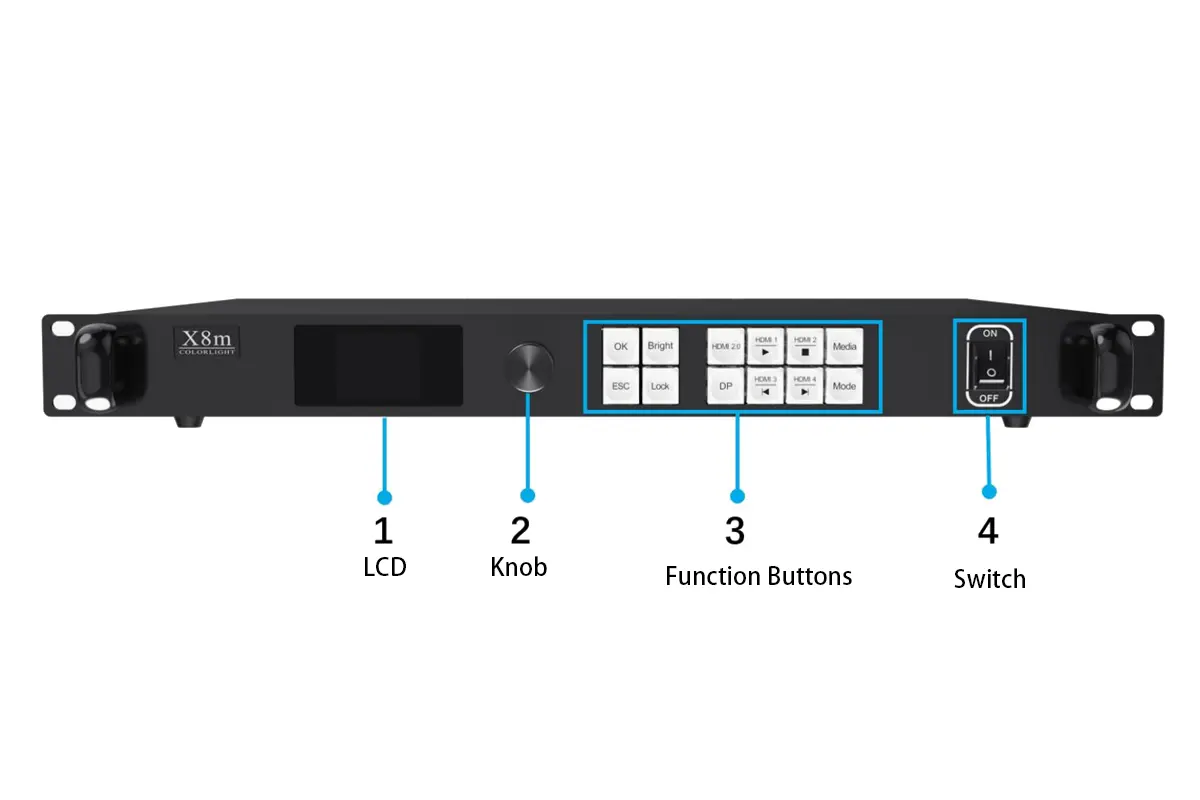
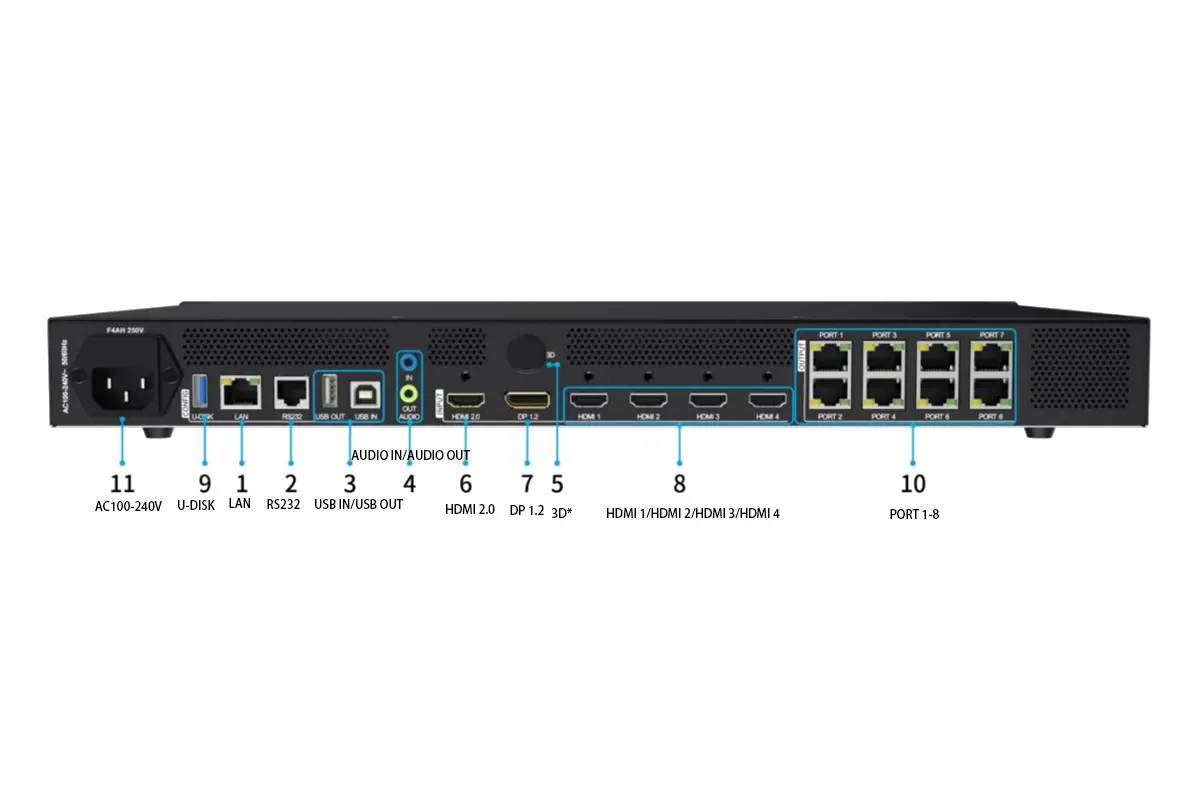
The front panel carries an LCD menu screen, a rotary knob, input buttons for HDMI 2.0, DP and HDMI 1–4, plus Bright, ESC, Lock, Media and Mode keys. The rear panel holds the 4K and 2K inputs, eight RJ45 output ports, LAN and RS232 control ports, USB in/out, independent audio in/out, a 3D sync port and the AC power inlet.
Two practical points matter when you compare the X8m with other Colorlight models. First, the 5.24 million pixel figure is the total loading capacity at 8-bit, 60 Hz — it is not the screen resolution, and it drops when you raise the refresh rate. Second, the X8m is not an HDR device: the specification supports up to 4096×2160@60Hz with 8-bit colour on HDMI 2.0 and DP 1.2, and it does not accept interlaced signals, YCbCr 4:2:0 or 10/12-bit input.
2. Colorlight X8m Specifications (Official V1.0)
These figures follow the Colorlight X8m LED Video Controller Specification V1.0 published by Colorlight Cloud Tech Ltd. If you need the original document, the X8m specification PDF (V1.0) is hosted on our component site.
| Item | Colorlight X8m |
| Device type | Ultra-4K LED video processor and display controller, 1U 19-inch rack unit |
| Input ports | 1× HDMI 2.0, 1× DP 1.2, 4× HDMI 1.4, 1× USB drive port (U-DISK) |
| Maximum input resolution | 4096×2160@60Hz on HDMI 2.0 and DP 1.2; 1920×1200@60Hz on HDMI 1.4 |
| Maximum pixel clock | 600 MHz (HDMI 2.0 / DP 1.2); 165 MHz (HDMI 1.4) |
| Custom input resolution | 8192×1080@60Hz or 1080×8192@60Hz on HDMI 2.0 / DP 1.2; 4096×512@60Hz or 512×4096@60Hz on HDMI 1.4 |
| Output ports | 8× Gigabit Ethernet (1G LAN) |
| Loading capacity | 5.24 million pixels at 8-bit 60Hz; 2.62 million at 8-bit 120Hz; 1.31 million at 8-bit 240Hz |
| Capacity per output port | Up to 650,000 pixels at 8-bit 60Hz (655,360 single-port maximum); 320,000 at 120Hz; 160,000 at 240Hz |
| Maximum canvas size | 16,384 pixels wide × 8,192 pixels high |
| Layers and windows | Up to 6 windows with one layer each; layers can overlap; minimum window size 64×64 pixels |
| Audio | 1× independent audio input, 1× independent audio output, HDMI and DP audio decoding |
| Media playback | USB drive playback of images and video; NTFS, FAT32 and exFAT file systems |
| Preset scenes | 128 saved and recallable scenes |
| Synchronisation | Genlock: internal vsync, signal-source locking and auto-genlock by layers |
| Colour control | Brightness and colour-temperature adjustment, precise colour temperature, improved grey scale at low brightness |
| 3D output | Optional 3D sync port (active 3D glasses are an optional accessory) |
| Control ports | Front panel, USB control and cascade, RS232 (RJ11 6P6C), LAN, mobile apps, web control |
| Power supply | AC 100–240V, 50/60Hz, built-in fuse; rated power 52W |
| Dimensions (W×H×D) | 482.6mm (19″) × 44.0mm (1.7″) × 360.0mm (14.2″), no foot pads |
| Weight | 4.24kg net (9.35lbs), 4.86kg gross (10.71lbs) |
| Operating environment | -20°C to 50°C (-4°F to 122°F), 0%RH to 80%RH non-condensing |
| Storage environment | -30°C to 80°C (-22°F to 176°F), 0%RH to 90%RH non-condensing |
| Certifications | CE, FCC, IC, UKCA |
| Recommended cable run | CAT5e, maximum 100 metres between controller and receiving cards; output redundancy supported |
3. How Many Pixels Can the Colorlight X8m Load?
The X8m loads 5.24 million pixels at 8-bit and 60 Hz. The same hardware drops to 2.62 million pixels at 120 Hz and 1.31 million at 240 Hz, because higher refresh rates leave less bandwidth on each of the eight output ports.
| Output depth and refresh rate | Total loading capacity | Typical limit per output port |
| 8-bit @ 60 Hz | 5.24 million pixels | 650,000 pixels (655,360 single-port maximum) |
| 8-bit @ 120 Hz | 2.62 million pixels | 320,000 pixels |
| 8-bit @ 240 Hz | 1.31 million pixels | 160,000 pixels |
Two worked examples. A P2.5 indoor screen measuring 4.8×2.7 m holds roughly 1,920×1,080 pixels — about 2.07 million pixels — so one X8m drives it comfortably at 60 Hz and still has headroom at 120 Hz. A P1.86 screen at 7.2×4.05 m holds roughly 3,871×2,177 pixels, about 8.43 million pixels, which is beyond one X8m and needs either a larger controller or two units linked in one system.
Plan for headroom. Cabinet pixel counts, not cabinet numbers, decide the load: multiply the cabinet resolution by the number of cabinets, then compare that total with the table above. Leave margin for the canvas width and height limit of 16,384×8,192 pixels, for redundancy if you reserve a spare output port, and for future content that may need a higher refresh rate.
4. Inputs, Signal Formats and Limits
| Input | Maximum resolution | Frame rates and notes |
| 1× HDMI 2.0 | 4096×2160@60Hz (8-bit, YCbCr 4:2:2 or RGB 4:4:4) | 23.98, 30, 50, 59.94 and 60 Hz at 4K; up to 144 Hz at 1920×1200; up to 240 Hz at 1280×1200; EDID 1.3, independent EDID, audio input |
| 1× DP 1.2 | 4096×2160@60Hz (8-bit, YCbCr 4:2:2 or RGB 4:4:4) | Same 4K, 2K and HD frame-rate ranges as HDMI 2.0; EDID 1.3, independent EDID, audio input |
| 4× HDMI 1.4 | 1920×1200@60Hz | 29.97, 59.94, 30, 50 and 60 Hz; EDID 1.3, HDCP 1.4, audio input |
| 1× USB drive port | 4096×2160@60Hz for files | Standalone playback of video and images from a USB drive |
What the X8m does not accept. The V1.0 specification lists HDR as unsupported, interlaced signal input as unsupported, and YCbCr 4:2:0, 10-bit and 12-bit input as unsupported. If your source chain includes any of these, convert or switch the source before it reaches the controller, and check the EDID the X8m presents to the source device.
Custom resolutions are supported, which helps with creative LED shapes: HDMI 2.0 and DP 1.2 accept up to 8192 pixels wide (8192×1080@60Hz) or 8192 pixels high (1080×8192@60Hz), while the HDMI 1.4 inputs accept up to 4096 pixels wide (4096×512@60Hz) or high (512×4096@60Hz).
5. Multi-Window and Layer Configuration
The X8m builds a canvas from up to six windows, each carrying one layer, and layers may overlap each other. The number of 4K layers you place on the canvas decides how many windows remain available.
| 4K layers in the canvas | Maximum windows and layers | Largest layer combination |
| 1 | 5 | 1×4K + 4×HD |
| 2 | 2 | 2×4K |
| 0 | 6 | 6×HD |
Windows can be navigated, resized, cropped and switched seamlessly, with a minimum window size of 64×64 pixels. Genlock keeps output synchronised between the controller’s layers, and the 128 preset scenes let an operator recall a full layout — for example a two-window 4K conference layout or a six-window control-room overview — from the front panel or software.
6. USB Playback: Files the X8m Supports
The U-DISK port turns the X8m into a standalone player, which is useful for storefront screens and rental fixtures where no control PC is available on site.
| Item | Supported |
| Drive file systems | NTFS, FAT32, exFAT |
| Image formats | .jpeg, .png, .webp, .gif, .bmp (maximum 4096×2160@60Hz) |
| Video containers | .3gp, .avi, .flv, .m4v, .mkv, .mp4, .tp, .ts, .vob, .wmv, .mpeg |
| Video codecs | MPEG-1/2, MPEG-4, H.264/AVC, H.265/HEVC, Google VP8, Motion JPEG |
| Audio codecs | MPEG Audio, Windows Media Audio, AAC Audio, AMR Audio |
| Maximum video resolution | 4096×2160@60Hz with H.264/AVC, MVC or H.265/HEVC; 1920×1080@60Hz with MPEG-1/2, MPEG-4, Google VP8 or VC-1 |
7. Software and Control: LEDVISION, Web and RS232
There are five ways to operate the X8m, and most projects use two or three of them.
- LEDVISION software: the main configuration tool for screen settings, receiver mapping, colour depth and refresh rate. You can get the current build from our Colorlight LEDVISION and software download page.
- Front panel: LCD menu, rotary knob and function keys for input switching, brightness, presets and panel lock.
- Web control: the controller serves its own configuration page over LAN, so a laptop or tablet on the same network can operate it without extra software.
- RS232 and LAN commands: RJ11 (6P6C) RS232 and network control for central control systems, including third-party automation.
- USB control and cascade: USB type B input for a control PC and USB type A output for cascading units, plus mobile apps for basic operation.
Devices on a live installation are normally shipped with a project-specific IP address and login. Confirm the current address, login and screen-settings password with your supplier before you change anything, and record them in the project file so the next technician can reach the controller quickly.
8. How to Set Up the Colorlight X8m
- Check the screen plan first. Confirm total pixels, cabinet layout, refresh rate and the number of receiving cards, then check the result against the loading capacity table in section 3.
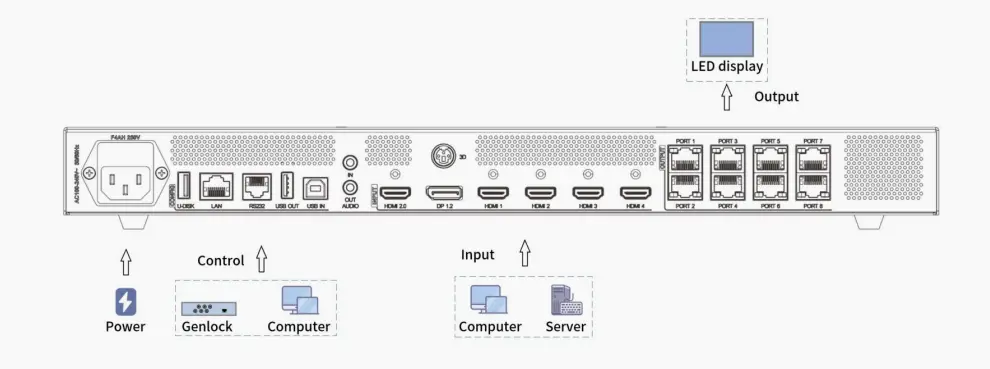
- Connect sources and outputs. Plug the 4K source into HDMI 2.0 or DP 1.2 and 2K sources into the HDMI 1.4 ports; run CAT5e (maximum 100 metres per run) from the eight output ports to the receiving cards.
- Power on. Connect AC 100–240V and switch the unit on with the rear switch; the LCD screen shows the operation menu and system information.
- Map the screen in LEDVISION. Open LEDVISION, go to Control > LED Screen Settings, detect the sending device and receivers, then map the cabinets in the receiver-mapping page and save the configuration to both the controller and the receiver cards.
- Test inputs and layers. Switch through HDMI 2.0, DP and HDMI 1–4, set the EDID and any custom resolution, then arrange the windows on the canvas and check the layer combination you need.
- Store presets. Save the finished layouts as preset scenes (up to 128) so operators can recall them from the front panel.
- Test USB playback and remote control. Load the media onto a USB drive, check playback, and enable web control or RS232 integration if the project uses a control system.
Quick troubleshooting for the X8m
- No signal from a laptop: check the EDID setting for that input, and confirm the source is not sending an interlaced signal or an unsupported colour format.
- Wrong or washed-out colours: the X8m accepts 8-bit input; switch the source away from YCbCr 4:2:0, 10-bit or 12-bit output.
- Capacity warning or missing cabinets: total pixels may have exceeded the limit for the selected refresh rate — check the 60 Hz, 120 Hz and 240 Hz rows in section 3.
- Intermittent cabinets: check CAT5e run length, RJ45 seating and output redundancy before replacing hardware.
9. Power, Environment and Rack Installation
| Item | Value |
| Power input | AC 100–240V, 50/60Hz, built-in fuse |
| Rated power | 52W |
| Main unit dimensions | 482.6mm × 44.0mm × 360.0mm (19″ × 1.7″ × 14.2″), no foot pads |
| Packing dimensions | 550.0mm × 115.0mm × 490.0mm |
| Net / gross weight | 4.24kg / 4.86kg |
| Operating temperature | -20°C to 50°C |
| Operating humidity | 0%RH to 80%RH, non-condensing |
| Storage temperature and humidity | -30°C to 80°C, 0%RH to 90%RH, non-condensing |
| Certifications | CE, FCC, IC, UKCA |
At 44 mm high and 4.24 kg net, the X8m occupies one rack unit, and its 52W rated power draw means it adds little heat to a rack or an equipment case. Keep the rear vents clear, and leave the operating humidity limits in mind when the controller travels in a flight case between outdoor events.
10. Colorlight X8m vs X12m: Which One Fits Your Screen?
The X8m and the X12m share the same 1U video-processor concept and the same 16,384×8,192 pixel canvas ceiling, but they differ in output port count and loading capacity.
| Item | Colorlight X8m | Colorlight X12m |
| Gigabit Ethernet output ports | 8 | 12 |
| Loading capacity | 5.24 million pixels at 8-bit 60Hz | Up to 7.86 million pixels |
| Maximum canvas size | 16,384 × 8,192 pixels | 16,384 × 8,192 pixels |
| Best suited to | Single-screen and multi-window projects up to 5.24 million pixels at 60Hz | Larger walls that need more output ports and higher pixel load |
The X12m column follows Colorlight’s official X8m/X12m product page, which lists the 12-port model at up to 7.86 million pixels with a maximum width of 16,384 pixels and height of 8,192 pixels. For the X8m, the 5.24 million pixel figure comes from the X8m Specification V1.0.
A simple rule of thumb. Add up the pixels of the whole screen, then choose: under 5.24 million pixels at 60 Hz one X8m is usually enough; between 5.24 and 7.86 million pixels step up to the 12-port model; beyond that, plan two synchronised controllers or a larger processor. If your canvas is well below 2.6 million pixels, ask your supplier about the smaller processors in the Colorlight X-series before you commit, because the extra ports may be unused.
Other controllers are worth comparing when your project mixes brands or needs SDI and optical inputs — see our notes on the Colorlight VX20 4K video processor, the Colorlight Z5 video processor and the NovaStar VX400 Pro.
11. Where the Colorlight X8m Fits
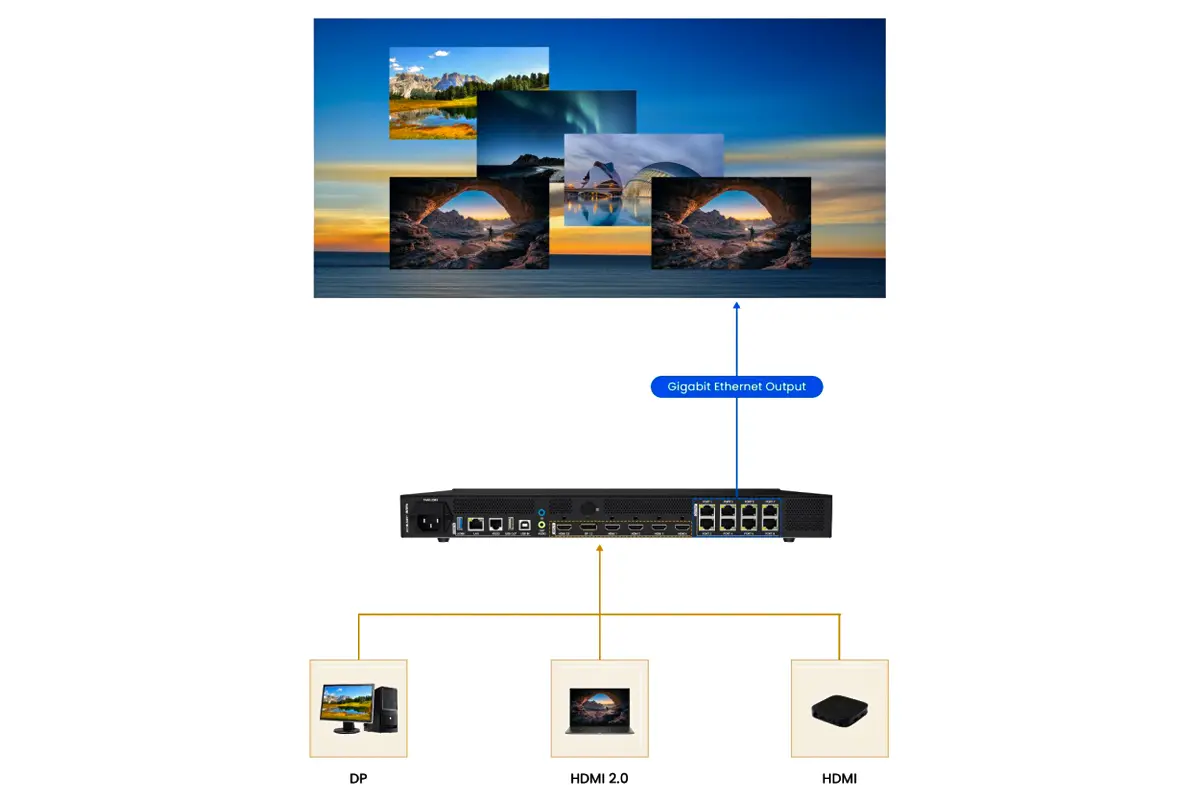
- Concerts, tours and live events: one 4K layer plus four HD layers lets a show feed cameras, graphics and playback into a single stage wall, and the front panel keeps control available if the show laptop fails. See our rental LED display range for tour-ready cabinets.
- Control rooms and corporate AV: six HD windows on one canvas suit monitoring walls and meeting-room video walls, with 128 presets for rapid layout changes.
- Broadcast and sports venues: HDMI 2.0 and DP 1.2 accept true 4K sources, and custom resolutions fit unusually shaped in-venue screens.
- Retail and digital signage: USB playback updates content without a PC, while the loading capacity supports large seamless storefront walls. Our commercial LED display buyer’s checklist covers the rest of the specification work.
If the screens are permanent, plan pixel pitch and viewing distance first: our indoor LED screen guide and outdoor LED screen guide show how pitch, brightness and cabinet choice affect the pixel count the controller has to drive.
12. Colorlight X8m Price: What Decides It
The X8m is a professional B2B controller, so there is no single public list price: quotes are built per project. Five factors move the number most.
- Quantity and project size: one controller for a meeting room is quoted differently from a multi-unit tour package.
- Destination and logistics: shipping, duties and delivery time change the landed cost.
- Accessories in the quote: CAT5e cabling, flight case or rack mounting, spare parts and receiver cards.
- Lead time: stock availability and expedited shipping for a fixed event date.
- Support scope: factory configuration, warranty period and on-site commissioning support.
To get an accurate price, send the screen size in pixels, the cabinet type and count, the refresh rate you need and the destination city. Our engineers will confirm whether one X8m covers the load or whether a 12-port model or two synchronised controllers are required, then quote the complete control package. Request a Colorlight X8m quote and include the screen plan if you already have one.
13. Frequently Asked Questions
What is the Colorlight X8m?
The Colorlight X8m is an Ultra-4K LED video processor and display controller in a 1U rack unit. It loads up to 5.24 million pixels at 8-bit 60 Hz through eight Gigabit Ethernet outputs, accepts 4K input on HDMI 2.0 and DP 1.2, and drives a canvas up to 16,384×8,192 pixels.
How many pixels can the Colorlight X8m control?
5.24 million pixels at 8-bit 60 Hz, 2.62 million pixels at 120 Hz and 1.31 million pixels at 8-bit 240 Hz. Each output port carries up to 650,000 pixels at 60 Hz, with a single-port maximum of 655,360 pixels.
Does the X8m support 4K input?
Yes. The HDMI 2.0 and DP 1.2 inputs accept up to 4096×2160@60Hz with an 8-bit signal and a maximum pixel clock of 600 MHz. The four HDMI 1.4 inputs accept up to 1920×1200@60Hz with HDCP 1.4.
What is the maximum canvas size of the X8m?
The maximum canvas is 16,384 pixels wide by 8,192 pixels high. Width and height are separate limits from the 5.24 million pixel loading capacity, so a very wide or very tall screen can hit the canvas limit before it hits the pixel limit.
How many windows and layers does the X8m support?
Up to six windows, each with one layer that can overlap other layers, with a minimum window size of 64×64 pixels. The count depends on the 4K layers in the canvas: one 4K layer leaves five windows, two 4K layers leave two windows, and a canvas of HD layers only supports six windows.
What is the difference between the Colorlight X8m and the X12m?
The X12m has 12 Gigabit Ethernet output ports and a higher loading capacity — Colorlight lists it at up to 7.86 million pixels — while the X8m has eight output ports and loads 5.24 million pixels at 60 Hz. Both are 1U processors with the same 16,384×8,192 pixel canvas ceiling.
What software does the Colorlight X8m use?
LEDVISION is used for screen settings and receiver mapping, and you can download the current build from our Colorlight software download page. The controller also serves a web configuration page over LAN and supports RS232, USB and mobile app control.
Does the X8m support HDR or 10-bit input?
No. The X8m specification lists HDR as unsupported, together with interlaced signal input and YCbCr 4:2:0, 10-bit and 12-bit input. Sources must be set to an 8-bit signal before the controller. If HDR or 10-bit processing is a project requirement, compare HDR-capable processors such as the Colorlight Z5.
Can I play video from a USB drive without a computer?
Yes. Copy supported files to a USB drive formatted as NTFS, FAT32 or exFAT, plug it into the U-DISK port and control playback from the front panel. Supported containers include .mp4, .mkv, .avi, .ts and .m4v, and H.264/AVC and H.265/HEVC files are supported up to 4096×2160@60Hz.
Where can I download the Colorlight X8m datasheet or manual?
The specification is published as the Colorlight X8m specification PDF (V1.0). Software, drivers and related Colorlight documents are collected on our Colorlight software download page, and HonghaiLED can supply the current manual with a quotation.
How much does the Colorlight X8m cost?
There is no fixed public price: quotations depend on quantity, destination, accessories, lead time and support scope. Send your screen size in pixels, cabinet count, required refresh rate and delivery city through our contact form and HonghaiLED will quote the complete control package.
Sources and Version Notes
Specifications on this page follow the Colorlight X8m LED Video Controller Specification V1.0 (Colorlight Cloud Tech Ltd, 2023) for loading capacity, input and output formats, window and layer limits, USB playback formats, power, dimensions and certifications. The X12m figures in section 10 follow Colorlight’s official X8m/X12m product page at en.colorlightinside.com. Where published figures differ between sources, this page follows the X8m Specification V1.0 and states the alternative.
Product specifications can change between production batches; confirm the current datasheet with your supplier before ordering. Page reviewed September 2026.
Related Posts
LED Screen vs LCD Screen: Differences & How to Choose
LED screen vs LCD screen is a comparison of two…
How to Choose the Best LED Lamp Beads for LED Displays
Choosing the best LED lamp beads for LED displays starts…

LED Packaging Technology: SMD, COB, GOB & MIP Guide
LED packaging technology determines how light-emitting chips are connected, supported,…

No Comments